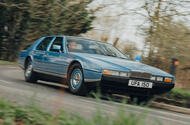
The jaw-dropping Lagonda saloon of 1976 saved Aston Martin – could it happen again?
On 20 October 1976, Aston Martin bet its future on a model so radical that it risked returning the company to the mire from which it had only just risen.
That car was the Lagonda saloon, and 50 years ago it was taking its first public bow at the British motor show in London, less than two years after Aston Martin had been plucked from receivership. Strikingly low, indulgently long and wide, with a razor-sharp wedge profile, the Lagonda bristled with daring levels of technology never before seen in the car world.
Had it been a concept for an ultra-low-volume model, fewer eyebrows would have been raised, but it was far from that: it was to be the company’s saviour, and everything was riding on its success. Five decades on and we know that Aston’s futurist foray did indeed pay off, more than 600 Lagondas being sold before production ended in 1990. Which makes me wonder: could an equally progressive product badged Lagonda work similar wonders in the late 2020s?
The historic name has, of course, been rolled out sporadically by the company – which remains officially named Aston Martin Lagonda Ltd over the past 20 years, albeit not with any great conviction. But former CEO Andy Palmer, who led one Lagonda revival effort during his stint at the helm in Gaydon, still believes the name could play a crucial role in restoring Aston Martin’s fortunes. After all, the 1976 Lagonda was a model featuring pioneering technology that was more than just gimmickry – and at one point it outsold all other Aston models by three to one. How useful would that be in 2026?
First, though, how did the now-dormant marque evolve after then Aston owner David Brown acquired it in 1947? The company first produced Lagonda and 3-Litre models in 2.6-the 1950s, and a DB4-based Lagonda Rapide between 1961 and 1965, but they were small beer compared with the more ‘mainstream’ Aston DBs. Designer William Towns joined the company in 1966, and his DB6 replacement, the DBS, entered production the following year as a two-door coupé, but it was also conceived by Towns as a four-door saloon.
For that car, Aston resurrected the Lagonda name and it entered production in 1974. Just seven examples were sold, though, which was too little too late, and by Christmas that year Aston was in receivership.
But help was soon at hand. In January 1975, Company Developments stepped in to save ailing Aston, and chiefs Peter Sprague and George Minden tasked Towns with creating an all-new product that symbolised the spirit of the age. That spirit was looking decidedly wedge-like (Lotus had just launched the Esprit and Fiat the X1/9 a few years before), so it was no surprise that Towns bucked every previous Aston design norm and presented an audacious, all-aluminium-bodied car, with its origami-style lines so crisp and sharp that they needed to be largely hand-formed (each car was to take 2200 hours to build).
The proportions were sleek and elegant, the body measuring a mere 130cm in height but a full 5.2m from its gracefully sloping tail to its shrunken, chromed front grille. It was Towns’ vision of the future, which, as it turned out, was as prescient as it was arresting.
If anything, the Lagonda’s cabin was even more forward-thinking. Aston’s Mike Loasby developed an advanced system of graphic and digital solid-state displays in conjunction with researchers at the Cranfield Institute. This was combined with almost 50 touch-sensitive switches arguably the precursor of modern haptic controls – that looked after everything from the pop-up headlights to the front-seat adjustments. This high-tech feast was, more predictably, integrated within a luxuriantly Connolly leather-trimmed cabin with walnut inlays and deep Wilton carpets.
The Lagonda’s underpinnings, however, weren’t quite so space-age. Wherever possible, Loasby plundered the older V8 model’s parts bin to keep costs down. As a result, Tadek Marek’s all-aluminium, quad-cam, 5340cc V8 saw service once again, in this guise producing 280bhp at 5000rpm and a healthy 360lb ft of torque at 3000rpm (running with four twin-choke Weber carburettors; later fuel-injected engines produced around 300bhp). A Chrysler Torqueflite three-speed automatic gearbox delivered drive to the rear wheels, and Aston claimed a respectable 0-60mph time of 7.0sec and a 140mph top speed for the near-two-tonne leviathan.
Incredibly, Aston was ready to unveil the car at the aforementioned motor show just 21 months after the first design sketches had been drawn. The press was allowed access three weeks beforehand, so by the time the public set eyes on Aston’s show star it was already hotly anticipated, even though production was still two years away.
The Lagonda moniker worked well as a differentiator from Aston’s other models, and by the end of the show 80 orders had been taken. Extreme and controversial the Lagonda may have been, but it was set to save the company’s bacon.
That success endured, too. The Lagonda evolved through three generations – known as Series 2, 3 and 4 – before production finally ceased in 1990, after 620 cars had been built. While the 1986 Series 3 model introduced fuel-injected engines and a change to cathode-raytube (CRT) instruments, after a poor reputation earned by the earlier LED technology, 1987’s Series 4 received a significant restyle, with smoother body panels, larger (16in) wheels and the pop-up headlights replaced by three fixed units on either side of the grille.
Along the way, Aston encouraged high degrees of personalisation (Betamax video players, cocktail cabinets and boomerang aerials weren’t uncommon in the 1980s), while coachbuilder Tickford even stretched a few cars by five inches, if you thought your Lagonda was a bit too stubby. But however dated such excess appears today, up to 500 cars are still thought to survive worldwide.
And I’m about to drive a really early example. Albion Classic Cars’ Dimitri Labis, who owns this 1980 car, is one of only a handful of UK dealers who specialise in Lagondas. He tells me that the earlier models’ poor reliability was mainly caused by dampness in the complex electrics’ contacts, which led to corrosion. Not so much a problem in hotter climes, like the Middle East or California, which jointly took around two-thirds of Lagonda production, but in the UK and Northern Europe it tainted the car’s reputation.
All of which pales into insignificance when you stand back and admire the sheer majesty of the Lagonda today, its sheer size dominating the genteel village surroundings in which it’s now being photographed. Step inside, sink deep into the soft, futon-style driver’s seat and turn the key, and you’re presented with multiple red LED displays from the black face of the large, rectangular instrument panel. If it weren’t for the strangely small, Citroën-esque single-spoke steering wheel obscuring some of them, the presentation would work well – better than many a modern touchscreen, anyway.
A panel on the driver’s door contains 14 buttons, and touching two or three of them gets my seat into the right position. Shift into drive, pull away and, other than a distant woofle from the Marek V8’s exhausts, the Lagonda makes serene progress as it leaves our Kentish base, its 70-profile Avon Turbosteels mopping up the worst of the winter-ravaged road surfaces as it does so.
The steering is quite a revelation: high-geared, precise off-centre and with far less assistance than expected; once you’re accustomed to the car’s breadth, its handling is surprisingly good for a motor that is half a century old, with ample grip and minimal roll during cornering. It’s a bit of a hot rod too: while the auto ‘box saps some of the V8’s energy, a deep well of torque fills in any gaps and hurls you down the straights, blurring the numbers on the digital tacho.
Where the Lagonda does feel its age is in its overall control, the downside of its pillowy ride being that the body occasionally wallows and lurches over awkward surface cambers and imperfections, despite having a well-located de Dion rear axle. But I’ve driven many large saloons from this era and the Lagonda is still one of the more competent in this respect.
Returning to the original question, could such a groundbreaking car wearing a Lagonda badge entrance buyers once more? Aston has played down the idea, despite having toyed with the marque’s revival three times in the past three decades – admittedly all before current owner Lawrence Stroll’s takeover. “Our focus is on Aston Martin at the moment,” said a company spokesman when we put the question to them, “so we have no plans for Lagonda in the near future. But never say never…”
Palmer always believed Lagonda could complement its sibling brand in the market. “The Lagonda has always represented something slightly different within the Aston Martin family,” he says.
“It was never about noise or overt sportiness. Historically it stood for refinement, space and a kind of quiet confidence. I felt that character made it surprisingly well-suited to the electric era.”
Before his departure from Aston in 2020, it had always been Palmer’s intention to make Lagonda the company’s EV brand: “I felt electric propulsion lent itself naturally to the qualities Lagonda always embodied, namely smoothness, near-silence and effortless performance.” In other words, the perfect successor to the 1976 original.
The recent Lagondas
2009 Lagonda LUV
Aston pitched this concept as an LUV, or luxury utility vehicle, long before such a class of car existed. Sending its V12 power through all four wheels, it was created under the watch of Ulrich Bez, who announced the relaunch of Lagonda to coincide with the brand’s car manufacturing centenary.
The Lagonda name eventually returned to production in 2014 with this saloon, based on Aston’s Rapide platform. Costing $1 million, the ultraexclusive Taraf was powered by a 5.9-litre V12 and capable of 0-60mph in 4.4sec, on its way to a 195mph top speed. Just 120 Tarafs were made, primarily for the Middle East.
Launched at Geneva in 2018, this concept was part of CEO Andy Palmer’s second-century plan to reinvent Lagonda as an EV brand. Conceived as a Rolls-Royce Phantom-rivalling saloon, it was to complement the Aston brand’s planned transition to sustainable fuels. A Bentley Bentayga-rivalling SUV, the All-Terrain concept, was unveiled a year later.