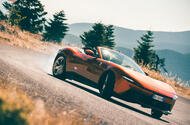
Replacement for the Roma Spider promises not only more speed, but extra refinement and, ahem, stability
We dubbed it Honey Mountain. Ferrari’s events team, whose carefully prescribed route we plain ignored, would probably have dubbed it the arse end of nowhere.
But in this game, sometimes you have to take a punt on an unsolicited location-pin fired over by snapper Jack Harrison at midnight. It’s how you end up on a spellbinding Greek pass the next morning, gleefully climbing ever higher in what is, in all objective ways, the least serious car in Ferrari’s expansive modern day line-up.
The pass in question is an abandoned-feeling stretch of the EO66 that takes you over the Oligyrtos mountains in the Peloponnese region. Think dense reaches of fir and pine, limestone massifs and impossibly verdant valleys, threaded with a scribble of asphalt smooth enough for you to unleash laugh-outloud speed but rugged enough to keep things interesting.
And slatted boxes. Hundreds of them, pastel-hued and weather-worn, dotting the roadside. They’re crammed with bees busy making liquid gold for the towns below. It all feels faintly mythical, but perhaps that is to be expected. Among his labours, Heracles dealt with the man-eating Stymphalian birds only a few miles from the highest point of the pass.
We’re in Greece for the media launch of the new AmalfiSpider. It costs £227,000 and is the rag-top version of Ferrari’s entry-level Amalfi coupe. If you didn’t know better, you might have thought it damned with faint praise in last night’s uncharacteristically concise technical presentation at the hotel. It was described by engineers as being “as easy to drive as possible” and existing as the best option for new Ferraristi who – get this – might find the company’s cars an “intimidating step up from what they’re used to”.
Is the Amalfi Spider a car that Ferrari actually enjoyed creating or one it merely feels compelled to offer, to get people hooked on Maranello magic before their heads are turned by wares from Gaydon and Stuttgart?
The truth will soon become obvious, but this car is without doubt more approachable than the drop-top Ferraris it subordinates, the midengined 296 GTS and flagship, 1036hp 849 Testarossa Spider. I do wonder if positioning it as the dilettante’s choice sells it short, though. Let’s face facts: here we have a short wheelbase, steering response with which you could draw blood and a 3855cc twin-turbo V8 laying down 561lb from 3000rpm and 631bhp (spins faster than ever, too).
There’s also the small matter of a new Race mode, in which the fervour of the electronic stability systems has been diminished versus what you got in the old Roma Spider. ‘Easy to drive’ could be rebranded as ‘invites you to get unhinged, pronto’.
Before then, there are prosaic but nonetheless important elements. The freshly laid, glass-smooth motorway that takes us over from Attica, across the vertiginous slash in the landmass that is the manmade Corinth canal and into the vineyard-dotted Peloponnese bush is a chance to settle into the car’s unpretentious, cupped seats and take stock of what Ferrari says are myriad improvements to “quality of life on-board”.
The new electrohydraulically folding roof – five layers of fabric, three of rubber – is said to offer the same noise-insulation as a folding hard top, and in fairness this is difficult to dispute. The AmalfiSpider is a closer match for Bentley’s Continental GTC, as goes rolling refinement, than for any equivalent Porsche 911 convertible. I don’t think an Aston Martin Vantage Roadster, on its comically wide and roaring tyres, comes close either.
More impressive is what happens when you put the Amalfi’s roof down, which takes 13.5sec and can be done at 40mph. Keep the side windows up, deploy the rear seat-back panel as a turbulence-mitigation measure (it flips out to sit horizontal) and you need barely raise your voice to chat, even on rapid motorways runs. Uncanny.
The nose lift – not that you constantly need it, with the Amalfi’s unthreatening ride height – is also new and integrated into the Magneride dampers. Along with their springs, the dampers offer a broader spread of characteristics than Roma owners will know. Comfort mode is softer than before, Sport and Race firmer. And as ever, whichever mode you opt for via the anodised nub of the manettino, you can depress the dial itself to enter the ever-excellent Bumpy Road mode. This sets the suspension to its softest, no matter what the engine, gearbox and ESC are doing.
The Amalfi’s languid waft and confounding suppression of wild and tyre noise – that is, its phenomenal capability as a serious-distance GT car – can lull you into a false sense of security. In this case the brutal awakening comes when we leave the motorway via a wickedly tight corkscrew slip-road. After only deploying a couple of degrees of lock for the last 50 miles, in my mind the steering has become simpatico with the languid body movements you get in Comfort.
This is, of course, quite untrue. When I carry good speed and carve the Amalfi into this corkscrew using meaningful lock, the nose darts inwards so keenly that, just for a moment, a meeting with the Armco doesn’t feel out of the question. Clearly the Amalfi Spider’s EPS tuning is unchanged from that of the Roma Spider: this is the Max Verstappen school of sensitivity.
Your ability to live with and enjoy the vivid effects that your steering inputs have on the swinging, power-domed nose will define your suitability for Amalfi ownership. The helm of the 911 GTS Cabriolet is slower, more natural and gives the gift of letting you revel in the kinematics of camber and castor as the car straightens post-apex. Anybody can enjoy it without having to adjust. Like in all modern Ferraris, the steering here is more confected and provocative, being keen to take advantage of having an engine nestled so far back you could almost stub your toe on it. There are serious rewards on offer, but you have to be game.
We should also discuss the new body. Both cars were overseen by Flavio Manzoni, but the Roma’s tapered snout and pseudo-grille are firmly out, replaced by a more monolithic aesthetic. The Amalfi is a smart grand tourer and the hint of boat-tail is rather a lovely one, but it lacks its predecessor’s eccentric, darting elegance. It’s just a bit more ordinary.
Underneath the body the two cars are essentially unchanged. This becomes obvious when you notice the identical claimed dry weight of 1556kg for Roma and Amalfi Spiders. However, there are tweaks. The turbos now spin faster in order to help pump peak power up from 29bhp in the Roma to the Amalfi’s headline 631bhp. There are also lighter camshafts that raise the flat-plane crankshaft’s head room by 100rpm to 7600rpm. And finally there are the carbon-ceramic brakes, which are now gripped courtesy of a by-wire mechanism. It means that, behind the scenes, you benefit from the ABS Evo system originall masterminded for the 296 GTB supercar.
To reach the foot of the Oligyrtos range, you need to join the EO66 at the comatose township of Nemea. As the buildings peter out, there’s a snaking run that slowly rises through olive groves and corridors of dense reeds, inhabited only by the occasional Mk2 Mitsubishi L200 that all the farmers here seem to drive.
With the manettino in Sport and Bumpy Road mode engaged, the Amalfi Spider is stunningly supple and cohesive – unrecognisably so compared with the California that started this lineage back in 2008. It has verve and togetherness. Where the nose goes, the tail obediently falls in with a purposeful squat, dropping the four tips of the reworked exhaust plumbing an inch or so closer to the road under power. It’s effortlessly quick.
Speeds inevitably rise and very soon, all thoughts of the soft-close doors, the new physical steering-wheel controls (a vast improvement on the derided haptics) and rolling refinement have faded. But the engineers were right: this is an incredibly low-cortisol Ferrari when you’re just mooching. Which only heightens the surprise and the delight when you’re not.
And now we reach the pass. The only real way to go is to select that freer Race mode, at least until you have a good understanding of the car’s transition from grip to slip. This can happen rapidly but in the dry it never happens unexpectedly.
The V8 is also precise enough for anybody to enjoy gently over-rotating the notably narrow (285-section) rear Goodyears on exit, for a tiny opening of lock. Given half a chance, the car will slither everywhere in such fashion. Or you can smash the torque in and ride out a filthy great broad slide, although you need to select ESC Off mode for this. Does any other Ferrari invite you to steer using the long, indulgently sprung throttle pedal as enthusiastically as the Amalfi?
At the same time, this new chassis is more forgiving than before. In Sport or even Comfort modes, if a corner ended up being sharper than expected, it wasn’t uncommon for the Roma’s tail to go wandering on a trailing brake. Some of us loved this impetuous, in-built agility, but the Amalfi , with its new 6D chassis controller, is less impishly mobile in normal driving. That’s handy in a car just 6mm narrower than the 12Cilindri.
We hit the top of the pass with the morning shadows receding and Harrison steps out to get a shot of the Amalfi’s nose next to one of the beehives. Unfortunately for him, I neglect to kill the booming V8 via the now-physical stop-start button. For the poor bees this is the equivalent of a T-Rex inserting its head through your bedroom window, so Harrison beats an undignified retreat and now it’s time for some conclusions.
We both feel the lack of sonic fireworks is disappointing. In fairness, Ferrari is now at the stage of having to use thinner engine oil simply to get this unit emissions-compliant. Along with the turbos and catalytic converters, creating real acoustic emotion is tough.
Neither do I much like the now-mandatory passenger-side display. And while Ferrari has reduced the stack height of the roof to 22cm when stowed, it does chomp into the boot space that is already limited by the hulking, Magna-engineered eight-speed transaxle lurking below. The Spider’s 172 litres with the roof down is reason to go for the coupé if you enjoy touring.
But this is otherwise a pretty stunning little Ferrari with some roguish charm. Consider the bowstring compliance that will be the envy of certain mid-engined machines; the balance and sled-like aptitude for oversteer; the uncanny refinement; the miniscule handling concessions from having more weight and a higher centre of gravity than the coupé; the V8 complemented by an exquisite, versatile dual-clutch gearbox.
The open-air Amalfi is pricier than rivals and, gulp, costs £49,000 more that its forebear did in 2023. But Ferrari has taken this car to a place that will be tough to match, let alone beat. Never tiring but never dull, it’s an underrated honey.
Specification
Details
Price
£227,260
Engine
V8, 3855cc, twin-turbocharged. petrol
Power
631bhp at 7500rpm
Torque
561lb ft at 3000-5750rpm
Gearbox
8-spd twin-clutch automatic, RWD
Dry weight
1556kg (with options)
0-62mph
3.3sec
Top speed
200mph
Economy
tbc
CO2, tax band
257g/km
Rivals
Porsche 911 Carrera GTS Cabriolet, Aston Martin Vantage Roadster, Mercedes-AMG SL63