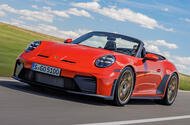
GT3 S/C is a convertible version of a world-beating sports car, and could be the one to have
This might seem like a niche within a niche, but here is the Porsche 911 GT3 S/C, in short a 911 GT3 cabriolet, so an open version of one of Porsche’s keenest driver’s cars. If you think that’s an odd thing, what with cabrios typically being floppier and therefore less good than coupés, you’re not alone.
“The number one talking point is ‘why?’,” admits the boss of Porsche’s GT division, Andreas Preuninger. Yet the S/C (Sports Convertible) is actually the answer to a simple question: what would the nicest 911 be like if you were going to use it only on the road?
Not a track-focused GT, then, but one optimised for use on your favourite empty roads of a balmy summer’s evening; a car containing all of the goodness of a GT3 Touring and the same mechanical interaction but with added soundtrack, given that noise is “one of the top three reasons people say they buy [a Porsche GT]”, says Preuninger.
Previous owners of Speedsters and Spyders with their fiddly manual hoods have loved that but told Porsche they would accept 10kg of added weight for the convenience of an electric folding roof. Here, they’ve got it. And the initial order bank suggests “we should have done it earlier”.
A typical convertible is, of course, heavier and more flexible (in the bad way) than the average coupé. In the 911’s case, it’s about 74kg heavier, only around 30kg of which is in the hood, because this roof, coming from the Turbo S, has a large degree of magnesium in its mechanism.
The GT division is a bit surprised that Porsche didn’t shout more about it when it was launched, given how light that is. The remainder of the weight is in the body-in-white, which is strengthened to retain as much torsional rigidity as possible (around 27kN/deg). The task was, then, to find 75kg to take out elsewhere, with the aim of having the S/C no heavier than a GT3 coupé could be.
To that end, it gets as standard the coupé’s Lightweight Package, comprising magnesium rather than aluminium centre-lock wheels, which save 9.1kg, plus carbon-ceramic brakes, which save another 20.3kg. Carbonfibre front wings and doors, which came on the brilliant 911 S/T but which aren’t offered on the GT3 Touring, come in too. You can tell them by their different sculpting. And the cabriolet gets the GT3’s carbonfibre bonnet, plus some carbonfibre suspension components out of the coupe’s Weissach Package.
Then the rear seats are deleted, and it’s available with a manual gearbox only, so the S/C comes in, fully fuelled and with washer fluid topped up, we’re told, at 1497kg. That’s a wee bit heavier than a manual GT3 (1462kg), but if we’re talking a car with PDK dual-clutch auto or a couple of options or a tuba left on the back seats, we’re in the realms of no discernible difference.
The weight distribution is changed a little, of course. And however stiff the shell of a cabriolet, it’s not a coupé. But Porsche’s clear implication is that the S/C is just as good to drive as the GT3, and Preuninger thinks that if you were blindfolded (he doesn’t recommend it), you would be pushed to tell the difference.
But Porsche’s clear implication is that the S/C is just as good to drive as the GT3, and Preuninger thinks that if you were blindfolded (he doesn’t recommend it), you would be pushed to tell the difference. “It’s not a convertible with some GT parts,” he says. “It’s a GT car with another bodyshell.”
The mechanical hardware, then, is the same as the coupé’s. It has the same 4.0-litre flat-six engine, naturally aspirated, revving to 9000rpm and generating 503bhp at 8500rpm and peak torque of 332lb ft at 6250rpm. It’s dry-sumped, with titanium conrods, individual throttle bodies and more.
It drives the rear wheels through a six-speed manual gearbox, there being no PDK option because that would make it around 30kg heavier and because “it’s a driver’s car, so one has to have as many points of interaction with the car as possible”. Almost two-thirds of GT3 Touring buyers opt for a manual, so they think that will be fine.
The suspension is unchanged from the GT3 Touring too – not just tweaked to make it feel as much like that car as possible but actually the same. “We considered this would be a big role in development,” says Preuninger, “but we didn’t have to do anything.” Softening it off, which was their initial thought, took too much precision away, so they went back to the base settings: “It’s not a miracle, because it’s not heavier than a standard GT3 Touring. We always came back to the baseline.”
The S/C costs £206,245 on the road, which, by the time you work out what the options would cost on a coupé, leaves it as a similar value proposition to the coupé. And it’s not strictly limited in production number: it will just comprise part of the GT3 line-up, at least until the car is forced off sale by the fact it won’t meet the Euro 7 emissions rules due to apply from November next year.
What is for now exclusive to the S/C is a Street Style Package, involving some rather elaborate decorative touches for £24,110. So what’s the S/C like? Lovely, perhaps inevitably.
The lightweight sports seats do seat you quite upright, which makes for a pretty focused driving position, before a round steering wheel and a set of digital instruments that puts the rev counter front and centre (you can customise it so that 9000rpm is at 12 o’clock if you like). You need to twist a key-like lever rather than press a button to start it, which I also like (it’s more intuitive if you stall on a circuit was the GT thinking). The pedals are positive and the gearshift is short of throw.
Because of the engine’s quick response, it’s possible to be a little clumsy with shifting, but such is the linearity of it that it’s easy and satisfying to get it right. That the engine and gearbox combo is already a large part of what’s so enjoyable about a GT3, having no roof on the matter amplifies the appeal. Forest areas or tunnels where sounds reverberate become real joys. And there’s a wind deflector that reduces buffeting to just about nothing.
The rest of the GT3 dynamic experience is all but there too. The steering is keen, the body is tightly contained (there’s two stage-damping; the softer, Sport, is best on the road), agility is high and that keyed-in feel, where you know exactly what the car is going to do, is absolutely present.
With a gap of several months since I last drove a coupé, and in unfamiliar territory, I wondered if it was cognitive distortion telling me that the S/C didn’t feel quite the same as a coupé.
But on reflection I do think you can discern a difference, that while it’s no less agile overall, some weight balance has shifted rearward, and that there’s less uncompromising solidity and fingertip-tactile steering precision than in a coupé (with a roll-cage, particularly). In a road car, though, that’s not necessarily a bad thing: any shoulder-height body movement communicates to you that things are happening.
Or I might be imagining it. That I couldn’t say for sure tells you how much a GT3 the S/C feels. As Preuninger said, it’s not a cabriolet trying to be one, it’s the real thing with added air and sound.
Porsche 911 GT3 S/C
Verdict: A soft-roofed version of one of the greatest driver’s cars on Earth. Can you tell much difference? There’s a negligible loss of fun even if you can.
Technical Specification
Price
£206,245
Engine
6 cyls horizontally opposed, 3996cc, petrol
Power
503bhp at 8500rpm
Torque
332lb ft at 6250rpm
Gearbox
6-spd manual, RWD
Kerb weight
1497kg
0-62mph
3.9sec
Top speed
194mph
Economy
20.6mpg
CO2, tax band
310g/km, 37%
Rivals
Aston Martin Vantage Roadster, Ferrari 296 GTS, Mercedes-AMG SL 53