It cost £150 and spent a decade in the elements; now it’s time to decide this iconic hot hatch’s future
When you’ve left a car under a sheet on a driveway for a decade, you will probably assume that peeling back the cover will reveal an unsalvageable heap of metal.
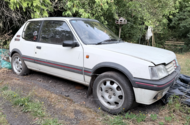
Happily, this wasn’t the case last weekend when my dad and I uncovered his cherished Peugeot 205 GTi, parked outside a friendly neighbour’s house since 2016.
He bought it back in 2003 for the grand sum of £150 – an outrageous figure when you consider that tidy 1.9 GTis regularly fetch well over a hundred times that figure today.
When I was a kid, it was a cheap, practical runaround that he used for commutes and school runs.
As I got older, my dad started using it for amateur motorsport and took part in various autosolos and autotests, with me gleefully riding shotgun. It may have been getting on in years, but this little Pug was well at home on these tight, twisting courses, where its taut body control and tactile handling helped us to outshine some of the more modern modified cars we were competing against.
In the late 2000s, the 1.9-litre lump started to show its age, and the head gasket eventually gave up. It was soon replaced and the 205 was back on the road – until it failed again in more dramatic style while competing in an autosolo at Donington Park, with water pouring out the front of the engine.
Rather than mend what was clearly an expired engine, my dad sourced a second-hand lump from eBay and fitted it himself. But only a few years later, the newer XU9 engine blew, the white smoke billowing from the exhaust suggesting it too was terminally damaged.
The 205 duly sat in the garage for a few years before its space was commandeered by my 1990 Mini Cooper (cheers, dad). Unceremoniously relocated to our neighbour’s driveway, it sat parked under a cover, where it has remained for the past 10 years, hunching ever lower as its time-worn tyres gradually flattened off at the bottom.
Which brings us up to today – and for various reasons, the Peugeot now needs to be stored elsewhere, so my dad and I warily headed over to go and inspect it. Given the propensity of old French cars to rot and the sub-optimal British weather conditions it has been exposed to since 2016, we expected to find no more than a twisted, unrecognisable heap of rust that even the scrap man would turn down.
But as we carefully prised back the tarp, it became clear that we didn’t need the dustpan and brush after all, as the Pug wasn’t in as bad a condition as we had feared – far from it, in fact.
Remarkably, the body is free of any terminal corrosion and won’t need any structural work. There’s a bit of surface rust on the lower wheel arches, the roof and around the windscreen, but all the important parts like the sills, boot floor and bulkhead are all in good health.
Our neighbour clearly has some sort of Mediterranean microclimate going on around the side of his house.
Less happy (albeit more predictable) news is that the rear axle has seized and will need to be replaced, but these are fairly easy to source and can be picked up for less than £500. The engine will also finally need that inevitable full rebuild; the initial diagnosis is that the rubber O-ring seals that sit at the bottom of the cylinder liners have failed. We’re pretty sure the block is cracked too.
The colossal spider that greeted us when we opened the boot and the mouse that has torn the back seats to shreds (let’s call it lightweighting) will both need to find new homes too.
But before we get the spanners and the Waxoyl out, there are choices to make.
Seeing as it isn’t a crumbling mess and is certainly a project worthy of restoration, we could feasibly sell it on and let someone else give it a new lease of life.
My dad is tempted by the idea of turning it into a competition car for road rallies, targa rallies and hillclimbing. Of course we could go for a full nut-and-bolt restoration, but I like the idea of morphing it into a bit of a restomod, with a spruced-up engine, power steering and a Blaupunkt stereo. The cut-price Tolman treatment, if you like.
So what do we do? Should we sell it on in the hope that someone else will rescue it; transform it into a stripped-out rally car for some grassroots motorsport; or explore the restomod route with OEM-plus upgrades for modern usability?
Whichever we choose, this seminal hot hatch is returning to the road – and not before time. It has a decade of frantic, flat-out antics to catch up on.