Lexus is aiming for the new LFA to feel like its predecessor behind the wheel – without howling V10 sound
Lexus plans for its electric LFA hypercar to feel authentically like its legendary predecessor to drive – but that doesn’t mean simply faking its howling V10 engine note.
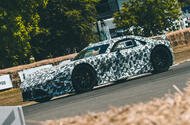
Making its dynamic debut in prototype form at the Goodwood Festival of Speed, the new LFA is effectively the EV twin of Toyota’s V8-engined GR GT supercar.
Precise technical details remain under wraps, but it’s understood to be the first production Lexus to use solid-state batteries (SSB), which are vastly more energy-dense than today’s liquid-chemistry packs.
Built around the same lightweight aluminium architecture as the GR GT, the LFA is similar in silhouette but much less aggressive and overtly race-influenced in its styling – which concept designer Shogo Kasamatsu said is testament to the influence of the ICE original.
“The LFA itself was a very humble design, very artistic, and based on its true function,” he explained, highlighting the relatively minimalist and subtle look of the new car, relative to its Toyota sibling.
Kasamatsu added that the rationale behind the design was to “express the message, rather than our overall design language”, so the concept didn’t necessarily need to look like Lexus’s current production cars.
He said the design is “almost” indicative of the final production car, which is “almost finished” ahead of a planned launch next year.
Its primary raison d’être, according to Kasamatsu, is to “challenge” established conventions around performance EVs. “Many people don’t believe that battery [power] is exciting right now,” he said. “This is a huge challenge.”
Yukihiro Yukita, general manager of the LFA programme, concurred, admitting that lack of demand for high-priced sporting EVs is “our biggest challenge”.
However, he added, Lexus wants to be a “leader” in convincing supercar drivers to make the jump from ICE to EV power, and an authentic driving experience will be key to achieving that.
“What I get from the market is that a BEV is fake,” he said, “because we imitate the sound [of an ICE] – but that’s not something we want to do.”
Yukita said that rather than simply mimic the sound of an engine or the feel of a gearbox, Lexus wants LFA drivers to “feel like they are driving with an engine”.
He acknowledged that one of the primary “demerits” of an EV, aside from the inherent added weight, is that “we lose the sound or the vibration, which gives a big impact to the five senses of the driver.”
But on the other hand, he continued, an EV sports car can leverage the increased responsiveness and linearity of electric motors, which “we cannot get from an engine”.
Plus, engineers are able to “eliminate all those sounds or vibrations that are not useful”, which means “we can reset to zero and then discuss what we want to create in redesigning the sound or vibrations, which can have a good impact on the five senses”.
Yukita acknowledged the efficacy of Hyundai’s and Porsche’s synthesised EV powertrains but said: “We’re not just wanting to replicate the sound of the engine: we want to redesign the sound itself.”