Ready for action: Simple and reliable Jeep is easy to work on and appreciate
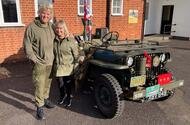
“We always get the first car parking space at Asda!” jokes Ian Watson about his Willys Jeep, which he has owned for 10 years.
“With the machine gun mounts – I have a couple of 30-calibre guns at home that fit them – it looks pretty serious.” I hope he removes the – fake? – hand grenade attached to the dashboard when he and wife Viv pop into the supermarket.
Ian’s Jeep is an early example – a 1941 ‘Slat Grille’ (when Ford also began producing jeeps for the war effort, it swapped the grille for a simpler piece of pressed steel to speed up production).
“It was shipped out to the South Pacific just two days after Pearl Harbour,” says Ian. “After the war, the Americans abandoned much of their equipment, and this Jeep remained in the Philippines. Eventually, it was run into the ground, but a museum in Manila, recognising its value as an early model, bought and restored it. When the museum closed, all the exhibits were sold off on eBay, which is how I came to buy it. It was more or less in its current condition and cost me £17,000, but today an early ‘slat grille’ Jeep goes for around £34,000, so I haven’t done badly.”
Ian’s Jeep is powered by the Willys ‘Go Devil’ engine that most Jeeps used. It’s a 2.2-litre inline four-cylinder flathead, or sidevalve, motor. “It leaks oil like a sieve, and because it was used in a hot country, it has a second radiator to keep it cool,” he says.
“It makes only around 60hp but just a little more than 100lb ft at 2000rpm, so it pulls well from idle. In fact, it feels a bit like a tractor! It’s certainly as slow as one, with 45mph the fastest I’ve had out of it. Not that I’d want to go much faster. The brakes are hydraulic but aren’t very good. It has cart springs at the back, too, so you do get thrown about. You have to hang on; I’m conscious I might fall out, so we’ve fitted door straps. Soldiers back in the war were a lot smaller and could cling on more easily than a big fella like me.”
Ian’s Jeep has a three-speed manual gearbox and, being permanent four-wheel drive, a transfer box with high and low ranges. The handbrake works on the driveshaft and, says Ian, holds the vehicle securely. He adds: “A Jeep is a reasonably simple thing. I can do most jobs on it, but those I can’t I farm out to a Jeep specialist in Milford, near Godalming. Spare parts are easy to come by. Because so many Jeeps were made, it’s possible to get almost any bit that you need. It might be original too, although there are many new parts now coming out of India.”
Ian and Viv do around 500 miles a year in their Jeep. “Because it’s quite slow, it can be frustrating for those drivers following us, but people do love to see it about. When we first bought it, a lot of veterans would come up and reminisce, but they’ve passed on now. I keep it in my garage, one half of which has military memorabilia associated with it. The other side, where I park my 1968 Mini Moke, has 1960s memorabilia.”