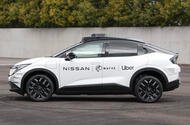
Japanese car maker’s plans are part of massive collaboration with Uber, Nvidia, and Wayve
A pilot scheme using Nissan Leaf robotaxis is set to be launched in Tokyo later this year, subject to approval by the authorities. The scheme is part of Nissan‘s plan to deploy robotaxis worldwide in collaboration with Wayve, Nvidia and Uber.
The major difference between the Leaf-based taxis and regular retail Leafs is that Nissan is developing fully redundant systems for the robotaxi versions. This is a widely used practice in safety-critical technology, such as the fly-by-wire systems used in aircraft, which have two or more totally separate systems to do one job in case one fails.
Level four means it needs no intervention by a human even in an emergency and pedals and steering are not necessarily installed at all. It also means the conditions it can drive in are restricted – to a specific geographical area, for example – and it is aimed at robotaxis and urban delivery vehicles.
The next step up is level five, which defines fully automated vehicles capable of driving anywhere in any conditions. The Drive Hyperion platform incorporates essential hardware such as cameras, radar, lidar, ultrasonics and in-cabin sensors.
As a ready-made platform, it allows engineers to focus on the job of developing automated vehicles like the Leaf. Wayve AI Driver is literally the brains behind the operation and is described as “rooted in end-to-end AI” learning from real-world data and working without the need for detailed high-definition maps and to navigate in real time.
The term ‘end-to-end’ AI is jargon that essentially means a level of intelligence in the true sense of the word. Show end-to-end AI the finished product and it can work out how to achieve the same result without the need for human intervention to spell out individual steps.
The Leaf robotaxi will have a comprehensive array of sensors to give the robot car full visibility of its surroundings, including cameras covering 360deg combined with forward- facing radar and lidar.
All of that sensing will be used by AI Driver to understand its surroundings and make decisions. It will process the data from the sensors to figure out complex traffic environments and take safe decisions, says Nissan. As it isn’t relying on maps, it can learn how traffic situations evolve and it anticipates the impact of its actions on other road users.
Nissan is also planning to continue to refine its cars for use as robotaxis, including features to make the journey more interesting for passengers, such as intuitive cabin displays and communication systems.
Wayve and Uber intend to expand their robotaxi trials to more than 10 cities worldwide. AI Driver is designed to work with any vehicle platform (and so any manufacturer) and across all cities and driving conditions.