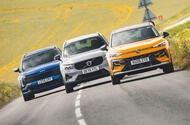
The new T-Roc has some best-selling shoes to fill, can it beat its rivals and do it again?
A comprehensive waiting party for the new Volkswagen T-Roc would include upwards of 30 rivals, depending on at which point you stop your tape measure.
The small (although not the smallest) crossover market is perhaps the most burgeoning of all: its population is split between internal combustion, electric and hybrid competitors, and it’s proving to be a merry hunting ground for fresh Chinese manufacturers. All of which gives the second-generation T-Roc a much more diverse challenge than the one faced by its predecessor.
Volkswagen has sold more than two million T-Rocs globally, and mainland Europe in particular adores them. The model has been a mainstay of the continent’s top 10 best-sellers for most of this decade, although it is typically outdone in the UK by both the Golf and the Tiguan, which neatly bookend it in VW’s line-up. If this reboot aims to shift the narrative, then, the pair of rivals we have here are just two of the cars the T-Roc must conquer.
Britain’s most bought cars were all traditional hatchbacks and saloons in the early noughties, but the SUV takeover means nearly the entire top 10 is now populated by 4.5m-long cars with a pumped-up ride height. Kia has now registered more than 500,000 Sportages in Britain, with over a third of those sold during the model’s current fifth generation, which hasn’t left the top 10 since its 2022 launch.
The Volvo XC40 made its debut back in 2017, scooped Car of the Year honours in early 2018 and has remained on sale since, its evolution being slight and superficial. Spot an early example while you tootle around in a brand-new one – the BaaderMeinhof phenomenon makes you realise these things are everywhere – and drivers of the older specimen can feel pretty smug about how little has changed. Resolved design clearly sells, too, with the XC40 ranking as the UK’s seventh-bestselling car in 2025 – its eighth year on sale.
Its price helps. It looks and feels the most premium of our trio but commands little more money. XC40s begin at £35,860, and this plusher specced Plus has heating for the steering wheel, front and rear seats and windscreen, Pilot Assist semi-autonomy, keyless entry and a powered tailgate, all for just three grand more. Electric variants are now badged EX40 to make the XC40 badge mild-hybrid-only; choose between the 161bhp B3 and 194bhp B4, both powering their front wheels via a 2.0-litre turbo petrol and dual-clutch automatic transmission. Curiously, they claim identical economy and emissions figures.
The T-Roc undercuts it on paper, mind, starting at just £31,635 in base Life trim with a 114bhp 1.5-litre eTSI petrol, also augmented by an electrified starter-generator. You’ll pay upwards of £33,700 if you want the punchier 148bhp tune we have here. There are further trim levels to mine and a full hybrid powertrain joins its range towards the end of 2026, but the car we have here roughly matches the Volvo on both equipment and price if you click its option packs wisely.
The bargain of our trio is the Sportage, its prices starting at £31,395 with a manual gearbox – a possibility exclusive to this group. We have tapped up Kia for the best-selling variant of its best-selling car, though. This GT-Line Hybrid starts at £37,395; it’s £2500 more than base Pure trim but has an array of goodies to justify it. It also matches its rivals here on price while being far more powerful: its full hybrid system claims a 235bhp peak for both our swiftest 0-62mph time and plumpest fuel economy figure.
It is also the most practical, its rear seats being the only ones present to split 40/20/40 while its 587-litre luggage volume trounces the 475-litre T-Roc and 443-litre XC40. The Volkswagen will be a squeeze for taller adults in the back, but the Volvo accommodates them cosily (with greater visibility than its suave, kicked-up window line suggests) and the Kia positively overwhelms them with space – as you might hope for the longest, bulkiest car here. It’s the chunkiest to look at, too – it is perhaps this more rugged appearance that, allied to so much kit and the longest warranty here, shifts these things in such numbers so consistently.
The T-Roc’s reboot calls to mind the same moment in Ford Focus history when the more theatrical details of its first generation were ironed out in favour of something that blended in more easily. It’s also the only car here without a clamshell bonnet. Hardly a deal-breaker by any means, but once you spot the line slicing through its Canary Yellow paint (currently the only standard, ‘free’ option), your eyes are opened to its more austere feel in this company.
“It’s giving hire car vibes,” says editorial assistant Alex Wolstenholme, and it’s hard to disagree when the Volvo’s similarly clean interior design poses so much better as ‘minimalism’ thanks to its crisper and more tactile surfaces. We concur the XC40 is the most appealing design and the car that would pass most easily with a committee of car enthusiast mates. It feels like a bonus business-class upgrade in company such as this, slightly cheap gear selector aside (plusher trims get a glass item). And while I don’t usually love a portrait touchscreen, this one is well integrated and doesn’t suffer the ‘frisbeed in tablet’ feel of so many of its rivals – particularly those Chinese newcomers.
This is a near-decade-old design, don’t forget, but its most obvious signs of ageing are a fish-eye reversing camera and wired (rather than wireless) phone connectivity. The Volvo’s terrific built-in Google set-up means your device can genuinely take a rest, however: a particular highlight is the map display within the instrument panel. It never intrudes on your speed or rev readout and realises the rare knack of always showing the ideal level of zoom for your current instruction.
The XC40 has the largest engine of our group, but it makes immediate hints that you’ve not clambered aboard an off-menu driver’s car, most notably with its lack of shift paddles behind the steering wheel. But the rim itself is sensibly round, and it steers a car that’s deft and agile. Performance is modest, although the appealing little whooshes and hisses from its turbo at low revs and during short bursts of acceleration bring a smile to your face as you slip through traffic lights and junctions.
Its four cylinders sound coarse at high revs, but it is punchy enough in its mid-range that you rarely need to wring it out. The throttle pedal is a little aloof, and I do pine for some proper manual control over its transmission – you can flick its central selector left and right to shift gears yourself, but it’s simply not intuitive – or even a simple Sport mode to liven things up. Its only option is how heavy you would like the steering, and it’s inevitably the lighter setting that feels the most natural.
The XC40 is a long way from being a thriller, yet still it brims with satisfaction. It allies a depth of engineering to intelligent design to create a very, very appealing everyday car. It’s hard to identify a single thing it does to irritate or frustrate – a rare and increasingly seductive claim at any price point.
The shorter, lighter T-Roc is immediately a sharper, more nimble car to drive, but it feels precisely that: a car rather than a crossover. It seats you lower down than the others, and while you still have a chunky, sculptured bonnet to peer over, you get a pervading sense that what is good here is also good in a Golf (another best-selling top 10 stalwart).
Anyone upgrading from first-gen T-Roc to a second-gen model will need a brief acclimatisation period. There’s no longer a manual option, and the standard automatic gear selector occupies the right-hand stalk, displacing the wiper controls. Proudly nestled in the centre console is a twiddly dial with its own embedded screen, which allows you to cycle its functionality through volume, driving modes and an atmosphere selector to adjust the ambient lighting.
There are still remnants of the VW switchgear we long to see retired – those wretched climate control sliders are perched in front of its protruding touchscreen. But the dropped breadcrumbs of a return to physical controls are tantalising. They have even had a degree of fun in here: the interior door pulls now integrate into the armrests to bring some tactile fanfare to an otherwise plain cabin.
The paddles behind its wheel make it immediately perkier than the XC40, and its driving experience broadens the feeling, however hard this engine appears to be working – I daren’t imagine how strained its base 1.5-litre must feel. The T-Roc exhibits the most communicative steering and chassis of our trio, and it generally scuttles along the road with the same keenness as a Golf. Its front axle digs keenly into the surface, and the rear follows it with some pleasing neutrality.
It ultimately lets you impress upon it whichever driving style you like, requiring low effort yet placating a more rapid charge should the mood take you. It has the most responsive gearbox here, too: VW’s DSG is clearly in a very evolved state nearly 25 years on from its launch, and it’s gratifying getting stuck into its shifts. This specific T-Roc rides best in our group, although how many buyers will stick with these stock 17in saucers and their chunky sidewalls is hard to say. Expect its comfort to fade if you get excitable with the configurator.
It also provides a considerable amount of configurability. You have Eco, Comfort and Sport modes as well as an Individual setting that allows you to mix and match its elements, if you prefer. ‘Twas ever thus in Volkswagens, but it helps the T-Roc stand out here – which is jolly welcome when, for all its bright paintwork and brand-newness, it’s a little short on ‘wow’ factor.
Despite the Sportage’s dizzying sales volumes, it still has impact up close. Its headlights are enormous and its general design seems outlandish for something marketed to the masses. It is similarly extrovert inside, with a two-tone, two-spoke steering wheel and bolder layout. And, praise be, it’s full of buttons, with crucial stuff like the climate controls kept out of the central display and fixed firmly to the dashboard.
Beside the other two you can argue it’s a bit cluttered – enough to give you a sense of why recent interior design has favoured scooping everything up within the screens. In practical use the Kia is much more intuitive, of course, and everything feels reasonably high-quality in here, with harder plastics relegated to the lower dashboard and doors and the materials up top packing softness and subtlety.
Its much greater power figure doesn’t quite play out in reality. The larger battery of its parallel hybrid layout ensures it’s the heaviest here, and those extra kilos smother most of its extra muscle. Its 1.6-litre engine is louder than its rivals at high revs, and speed is communicated via a curiously dated digitised font.
The steering wheel doesn’t brim with feel, either (quite the opposite), and if you select the more urgent of its Eco and Sport modes, you’re lumbered with a heavy and sticky response that’s unpleasant enough to put you off entirely. Sticking to Eco is best in an electrified family car, however, even if its efficiency claims barely eclipse the T-Roc’s. While the Sportage you’re looking at is a sportier-billed GT-Line, complete with big, 19in wheels, Kia hasn’t followed the path of making it needlessly stiff or alert. It’s a soft, coddling car that hits its particular brief with a bullseye.
“The Sportage has plenty of power, but the throttle is quite strange to modulate,” says Alex. “The T-Roc looks and feels quite cheap to me. I’d say it handles nicely, although more like a hatchback, so it depends what people are actually looking for. The Volvo generally drives well and has a real feeling of quality here.”
Crucially, none of these looks out of place as a best-seller, and it’s easy to make a convincing case for each of the three. The T-Roc is the newest, shiniest car here and lays claim to the most involving driving experience. The Sportage is demonstrably the most practical, flexible and best value – if you prioritise pragmatism over passion, the Kia absolutely walks this test. But you’re reading Autocar, so I’d like to think you’re in pursuit of something more covetable.
The Volvo is the oldest car here, yet its design remains fresh. It so carefully balances the dynamism of the Volkswagen with the decorum of the Kia that it’s hard not to declare it the winner.
VOLVO XC40 B3 PLUS
VOLKSWAGEN T-ROC 1.5 eTSI 150PS LIFE
KIA SPORTAGE GT-LINE HYBRID
Rating
4 stars
3.5 stars
3.5 stars
Price
£38,610
£33,700 (£37,660 as tested)
£37,395 (£38,070 as tested)
Engine
4 cyls in line, 1969cc, turbocharged, petrol, plus 48V ISG
4 cyls in line, 1498cc, turbocharged, petrol, plus 48V ISG
4 cyls in line, 1598cc, turbocharged, petrol, plus electric motor
Power
161bhp at 4750-5250rpm
148bhp at 5000-6000rpm
235bhp at 6000rpm
Torque
195lb ft at 1500-4000rpm
184lb ft at 1500-3000rpm
195lb ft at 1500rpm
Gearbox
7-spd dual-clutch automatic, FWD
7-spd dual-clutch automatic, FWD
6-spd automatic, FWD
Kerb weight
1617kg
1474kg
1665kg
0-62mph
8.6sec
8.9sec
7.9sec
Top speed
112mph
132mph
121mph
Economy
42.7mpg
50.3mpg
50.4mpg
CO2, tax band
149g/km, 35%
128g/km, 31%
128g/km, 31%