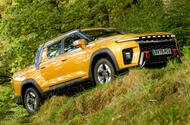
Revitalised brand brings car-like refinement and tiny tax bills to the pick-up segment with new electric 4×4
While pitching its new Musso Rhino as a traditional workhorse, KGM is venturing into new territory with its all-new Musso EV, an electric four-wheel-drive pick-up truck.
This is a very niche segment: it has only the Maxus eTerron9 and Isuzu D-Max EV or company, although the pool of electric pick-ups is set to expand with the arrival of the Toyota Hilux Electric.
Unlike the Rhino, with its body-on-frame chassis, the Musso EV borrows its platform from an electric car, the KGM Torres EVX.
Compared with the high-riding Rhino, then, the EV looks more SUV-like, with a noticeably lower ride height and longer wheelbase.
It has a sleeker, cab-back stance and its styling is more aligned with KGM‘s range of SUVs rather than the Rhino’s more rugged aesthetic.
The Musso EV is powered by a 80.6kWh lithium-iron-phosphate (LFP) battery that’s good enough for up to 236 miles of range.
On a very short drive around Oxfordshire, it returned 2.6mpkWh, which means it should cover more than 200 miles in real-world conditions.
While its real-world range isn’t outstanding, the Musso can still travel much further on a charge than the Hilux Electric (159 miles) and a D-Max (163 miles).
Hook the Musso EV up to a rapid charger and a 10-80% boost should take no longer than 36 minutes, or 10 hours if you plug it into an 11kW home wallbox charger.
Plus, like Kia EVs, the Musso features vehicle-to-load (V2L) technology, allowing you to turn the car into a giant charging station for small electrical appliances, such as a kettle.
The dual-motor powertrain makes 234bhp and 250lb ft of torque for a 0-62mph of 8.0sec. While that sounds fairly sedate, it’s more sprightly than the diesel-engined Rhino.
And while performance tails off fairly quickly, it has more than enough pace for nipping into gaps in traffic and motorway slip roads.
The choppy ride that afflicts the Rhino isn’t present here either. The EV may feel more floaty, but it’s more comfortable – although the low-speed ride can be quite brittle.
The Musso EV has also inherited the interior design of its SUV siblings, and overall it’s more interesting and colourful than the Rhino’s durable cabin.
It feels modern and upmarket, with good use of soft-touch materials on the dash and doors, so you could argue that it’s a more pleasant place to cover miles than the Rhino.
The copper trim on the dash and the ambient lightning certainly help give it a premium vibe.
I didn’t get to play around with the 12.3in central touchscreen much, but I got the feeling that it suffered from the same latency issues at the Rhino. It’s easy enough to navigate around but not particularly sharp or responsive.
That said, it does come with wireless Apple CarPlay and Android Auto, which you will probably use more often than KGM’s own software.
And, like in the Rhino, you can swipe down on the main touchscreen menu to access the shortcut buttons to turn off the overzealous ADAS.
Rear accommodation is more generous than in the diesel truck. Even though the bench is perched, head room is plentiful. Even with the seat fixed to my driving position, I had bucket loads of leg room back there.
I also preferred the Musso EV’s backrest, which was slightly more reclined than that in the Rhino, allowing me to find a more comfortable position.
While it’s quicker and more comfortable than the Rhino, the EV doesn’t have the load-lugging credentials to make it a viable farmhand or workhorse. It can carry only up to 690kg on its back and, while it can tow up to 2300kg, it is still some way off the 3500kg hauling ability of the diesel.
Given that ICE double-cab pick-ups have lost their BIK tax-busting benefits, the Musso EV presents itself as a tax-efficient alternative. With the BIK rate at 4%, you could pay as little as £30 a month to run it as a company car.
And because it qualifies for the government’s £5000 Plug-in Van Grant (PiVG), the Musso EV now costs from £39,995, making it substantially cheaper than the D-Max EV (£59,995) and eTerron9 (£54,696).
It may not be your archetypal cargo carrier, but the Musso EV is a credible alternative to an electric SUV. It’s hard to pin-point exactly who the Musso EV is for, but considering that it can travel much further than rivals and costs less than the Maxus, adventurous, lifestyle-focused drivers might like the idea of an electric car with a usable load bed and a decent range.
KGM Musso EV
Verdict: Comfortable, brisk and with tempting tax breaks, the Musso EV is a credible lifestyle truck, but compromised towing and carrying ability dents its appeal.
Specification
Details
Price
£39,995 (ex VAT, including £5,000 Plug-in Van Grant)
Engine
Permanent magnet synchronous motor x2
Power
234bhp
Torque
250 lb ft
Gearbox
1-speed reduction gear, AWD
Kerb Weight
2360 kg
0-62mph
8.0sec
Top Speed
110mph
Battery
80.6kWh
Range and economy
236 miles, 2.5 mpkWh
CO2 and BIK tax band
0g/km, 4%
Key rivals
Maxus eTerron 9, Isuzu D-Max EV