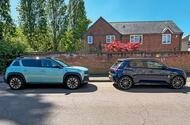
Renault’s practical new crossover comes face-to-face with its retro-styled electric sibling
I don’t like to brag, but I reckon I could currently be the most knowledgeable and experienced person in the UK on the subject of small electric Renaults. Perhaps excluding the people who sell them.
Not only have I recently swapped an Alpine A290 for its Renault 4 relation, but my partner and I have also just taken delivery of a new Renault 5 – giving me valuable lived experience of each of the French firm’s funky electric triplets.
As a result, I’m becoming pretty well versed in the differences between these sibling models – extremely closely related as they are. Naturally, the contrasts in character between my new 4 crossover and the souped-up, sporting-minded Alpine hot hatch that I had before it are fairly stark, but what’s interesting is the clear air I’m finding between the SUV and the standard 5, despite the fact that the two cars are notionally identical under the skin.
Last weekend, I took the 4 and my partner’s 5 out for an hour apiece on local roads to see exactly where their respective strong suits lie and it reinforced that the disparities go far beyond their different silhouettes.
For starters, the 4 is the markedly plusher proposition on battered UK Tarmac. Like my partner’s 5, the 4 rides on top-spec 18in wheels, but it is far more adept at isolating judders and jolts through the seat base and steering column – an attribute that comes into particular focus on city streets, where I confront a towering speed bump or chasmic pothole every 50 metres.
The 5 doesn’t ride harshly by any stretch but its lower ride height and stiffer dampers make for a slightly less composed treatment of such obstacles and that means it can grate after a day of chugging around town. The loftier 4 feels positively serene by comparison.
The trade-off, of course, is that the 5 is by far the more engaging car to chuck around enthusiastically: its steering feels dartier and more direct, it corners flatter, and the lower seating position puts you closer to the road, amping up the engagement factor.
The 4 is still an agreeably agile car, and feels tightly packaged and manoeuvrable despite the size increase, but it has obviously been tuned with more of a focus on liveability than liveliness.
It’s harder to tell any difference in straight-line performance, given the two use the same 148bhp front-mounted motor and there’s only about 30kg of added bulk on board the larger car. The 4 feels every bit as keen and gutsy when you want it to but is otherwise entirely smooth, quiet and predictable off the mark.
I haven’t yet noticed any efficiency improvement in the smaller 5, either, with both cars currently averaging around 3.7mpkWh in mixed use, for a range of 192 miles – though, based on previous experience, I’d expect the 5 to claim a tiny advantage on a long motorway run, but only to the tune of around five miles per charge.
The 4 scores a couple of extra points for having almost 100 litres more boot space and improved leg room in the rear (albeit still not quite enough: I can’t comfortably sit behind my normal seating position). But then the 5 saves you a couple of grand, spec for spec. It’s a tough call.
There are prospective buyers who’ll simply need the extra space the 4 offers, and others for whom the 5’s undeniable visual allure is simply too compelling, but my general takeaway is that both of these cars do their respective jobs pretty well, and your choice might have to come down, simply, to which one you like the most. Glad to be of service.