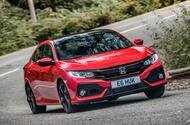
The Swindon-built 10th-gen Civic is an appealing, practical choice
Cars that wear the ‘built in Britain’ tag tend to err towards being luxurious, expensive and/or sporty – think Aston Martin, McLaren and Land Rover, to name but a few.
There are, however, a couple of reliable Japanese but British-built hatchbacks – one of them being the 10th-generation Honda Civic, a practical, fun-to-drive family car that was launched in the UK in 2017.
Unlike earlier Civics, this one was conceived as a single model for all markets. As the US was and is the largest, the British-built Civic hatch would fundamentally be designed for our friends across the pond.
Normally, this would fill us with trepidation, but it gave the Mk10 car an edge: the US’s preference for larger modes of transport meant this Civic was the biggest car in its class, so an obvious win for practicality. Furthermore, a big development budget meant the Civic improved in other ways: it was a bit lighter and better to drive than before, and its tech really moved the game on.
A Ford Focus or Mazda 3 will be even more enjoyable to drive, and a Volkswagen Golf will have tech that is easier to fathom, but the Civic is a great compromise – and it earned itself a four-star road test rating.
Residuals remain strong thanks to Honda’s stellar reliability record, but there’s a caveat to that, which we’ll come to.
But first, the interior. Unlike the slightly bloated exterior, the inside of the Mk10 Civic is restrained in all the right ways. The BMW-like driver-centric dashboard gives a sporty, wraparound feel, and the fabulous short-throw manual gearlever is in the perfect place. There’s lots of adjustment in the steering wheel and driver’s seat (set it to the lowest in the class, if you wish), too, along with well-aligned pedals.
All Civics get a digital driver’s display. A 7in sat-nav with reversing camera and Apple CarPlay/Android Auto is standard from Sport trim up, with base-level SE getting only a Bluetooth DAB radio. The touchscreen is laggy, but a plethora of physical controls means it’s not omnipotent. In the back, there is generous leg room and decent head room, while the boot holds 478 litres.
Trims range from SE through SR and Sport, with EX at the top. SE is quite basic, but SR has two- zone climate control, automatic wipers, all-round parking sensors and a leather steering wheel and gearknob. Sport adds heated seats, while Sport Plus gets adaptive suspension – it’s nice to have, but the Civic is comfortable enough without it. EX adds leather seats and a panoramic sunroof.
On the road, the Civic is mostly quiet and comfortable, although some road roar and a degree of unsettledness makes its way into the cabin on coarse surfaces. The handling is precise and responsive enough, and grip levels are fairly high, but there isn’t the verve and agility you get from a Focus.
There are three engines to choose from. The standard 1.0-litre three-pot turbo would be very recommendable if it weren’t for its wet belt, which can degrade and cause engine failure. Thankfully, the 1.6 diesel is only a little down on power (it has 118bhp compared with the 1.0’s 127bhp), is impressively refined and is more economical – expect 55mpg to the 1.0’s 45mpg. A turbocharged 1.5-litre four-pot with 180bhp rounds out the choices. It’s warm-hatch quick (we timed it to 60mph in 7.8sec) while hardly less economical than the 1.0-litre.
What to look out for
Engine: ‘Wet belt’ has become a dirty term with used cars, and the Civic is no different. The 1.0-litre is a lovely engine to drive, but the belt can fail as early as 40,000 miles, leaving a huge bill. If you replace it preventatively, budget £1200, but it could still go without warning afterwards. Turbos and the alternator are also weak points with this engine. The diesel suffers from DPF issues if continually driven on short, urban journeys, while the 1.5-litre petrol proves thirsty in the same circumstances (30mpg can be expected around town).
Gearbox: The diesel is paired with a six-speed manual or nine-speed automatic gearbox, the petrols the same manual or a CVT. The manuals are most common, and for good reason: they have a lovely shift action and are faster and more economical than the automatics.
Interior: The cloth seats suffer premature wear and stain easily, but leather was only available on top-spec EX cars. Plastics weren’t as well screwed together as they should have been in some cars, so rattles can be commonplace. Check the air conditioning works properly – the compressor is a known weak point.
Electrics: The reversing camera can suffer from water ingress, which blurs the image. Replacement is the only way to sort it.
Also worth knowing
Earlier this year, Honda recalled the 10th-generation Civic over an issue that could result in a wheel falling off the car while driving. Affected owners are being contacted, but if you have your eye on a used one, ask for the VIN to enter into the Honda website to check for updates.
A saloon was added to the range in 2018, to replace the Accord. It has an even larger boot (519 litres) than the hatch and more coherent styling, to some eyes. It’s a rare thing and wasn’t available in Sport trim or with the 1.5-litre engine.
The 10th-generation Civic was treated to a very light facelift in 2020 with an electric driver’s seat for the Prestige model (replacing EX) and more buttons for the infotainment system. You can tell it apart by the coloured inserts in the bumper.
There’s a flat £200 VED rate, while insurance groups range between 15 and 22 for regular models. A different beast entirely, the 316bhp Type R is group 38.
How much to spend
£4500-£7999 Early cars with more than 10,000 miles per year clocked up. Some are well into six figures.
£8000-£11,999 A nice selection of average-mileage examples with good history. There is no significant premium for saloons.
£12,000-£19,999 Low-mileage examples and late facelifts – they make up the bulk of the classifieds.
£20,000-£40,000 A range of Type Rs from early, high-mileage examples to those with only a few thousand miles.
An owner’s view
O’Baid Chaudhry: “I love that the Civic comes so well equipped as standard, so there is no requirement – unlike with the German brands – for specifying extras such as cruise control and heated seats. The diesel runs very smoothly and very economically, and it has plenty of power for the real world. Maintenance on mine has been minimal, with only basic servicing required.”