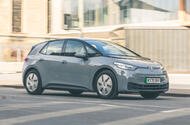
Volkswagen’s electric alternative to the Golf has a lot going for it now there are used examples aplenty
The ID 3 arguably had bigger shoes to fill than any car has ever had: it was charged with spearheading the ‘third age’ of Volkswagen – just as the Beetle had led the first and the Golf the second.
VW’s self-proclaimed third age was about electrification and the ID 3 was launched in 2019 as the flag-bearer for a new family of bespoke EVs with a fresh design language and digital-first interiors.
VW had ambitious plans for it to be a towering sales success. But its launch coincided with the Covid pandemic, and early examples were also hampered by software issues. So the ID 3 was more of a slow burner than a smash hit. But it has always been a good car-roomy, efficient and pleasant to drive – and with early examples now on sale from as little as £9k, it could be your ideal first step into the EV world.
That outlay can land you a 2021 ID 3 Pro (the middle of three battery options) with 50,000 miles. Facelifted versions with a longer range and a heavily updated interior start at less than £15k.
VW says the ID 3 offers as much interior space as cars from the class above. In reality, while it has more back-seat room than a BMW 3 Series Touring, the boot isn’t massive, at 385 litres.
There are also some frustrating ergonomic foibles: the 10in main screen (12.9in from 2024) is in charge of the radio, ventilation controls, heated seats (if optioned) and plenty of other gizmos that should be quick and easy to adjust but aren’t. The original ‘slider’ temperature controls were especially controversial because they didn’t light up at night, although that was rectified in 2024 as part of a facelift that brought a dramatic improvement in interior quality and made the infotainment much easier to use.
These gripes aside, the ID 3 is a compelling all-rounder and among the more dynamically adept EVs of its era. Acceleration from low speeds is smooth and quick in all versions, and even the lower-powered variants have enough muscle to get a lick on once you reach the open road.
Thanks to its rear-wheel-drive layout, the ID 3 also gets its power down in corners far better than some scrabbly front-driven EVs. It delivers balanced, predictable handling too – albeit a little short of truly engaging. You’ll want the closely related Cupra Born for that.
The ID 3 is passively damped as standard but the Sport Plus package adds fully adaptive dampers and ‘progressive’ steering, which works like a variable-ratio rack. The ride is quiet and there’s a relaxed sense of isolation to it aside from the ever so slightly firm edge to out-of-town cross-country progress. Both wind and road noise levels are low too.
The line-up starts with the Pure, which has 216 miles of range from a 52kWh battery (240 miles from 2024), Pro boosts that to 59kWh and 264 miles (268 miles after 2024). Pro S is next up, with 77kWh and 341 miles (345 miles after 2024).
The 79kWh GTX (pictured above) arrived in 2024 with 370 miles of range. It’s the fastest option, with 322bhp and 0-62mph in 5.7sec, but it’s not hugely more engaging than other variants.
According to owners’ reports, battery capacity has held up well over time – and the German Automobile Club drove 100,000 miles over four years in an ID 3 and the battery lost just eight miles of range. So as a used EV it looks a very tempting proposition, especially at those prices.
What we said then
31 March 2021: “Volkswagen has done a really thorough, objectively commendable job on this, its first and all-important ID-brand electric car. For those ready to step into an electric car of just the right size and with just the right usability credentials, this ought to give the ID 3 deserved consideration.”
An owner’s view
Dave Evans: “The car is comfortable and quiet on long journeys and the interior space is good but I feel the boot is undersized. I absolutely hate the software. It is slow to respond and I genuinely feel like a beta tester for VW, something I did not choose to be. I’m still keeping it, though.”
Buyer beware
Electrics: While the main high-voltage traction battery is proving to be robust, the 12V auxiliary battery in early models has been known to drain unexpectedly, leaving owners locked out of their cars or unable to start them. VW ran a service campaign to replace them in early cars to support larger over-the-air updates. Check this has been done on any prospective purchase.
Tyres: Because the ID 3 is relatively heavy (around 1.8 tonnes) and delivers instant torque to the rear wheels, it can chew through rear tyres surprisingly quickly. Inspect the tread depth. If they’re well worn, use it as a bargaining chip because good EV-specific tyres are not cheap.
Software: Early models suffered extreme software glitches. These should have been sorted via a series of over-the-air updates, but check for a crashy infotainment, erroneous speed sign recognition and smartphone mirroring issues.
Also worth knowing
Navigating the equipment levels of the ID 3 can feel a bit like cracking a code. VW has continually revised the line-up during the car’s life, shifting from a complex pack-based offering to a much simpler, traditional trim structure. You can get lost trying to decipher it and find the ideal combination or you can compile a list of kit you really need and simply rule out any cars without it.
Things got easier after 2023, when the ID 3 line-up was slimmed to Life, Essential and GTX trims, with options on top.
Apple CarPlay and Android Auto are standard on all models, which helps. However, a heat pump-which warms the cabin much more efficiently in winter, preserving range – was an expensive optional extra and you’ll want one if you do a lot of winter driving. Look at the original spec sheet or check the screen’s climate control menu if unsure.
How much to spend
£9000-£13,999: Previously written-off cars can be found for less outlay than this, but high-milers with a clean history start here.
£14,000-£17,999: In this bracket, average-mileage Pros (with around 40,000 miles) are about the same price as Pro S cars with twice the mileage.
£18,000-£24,999: Desirable facelifted cars become available here, with their nicer interiors and improved range.
£25,000-£48,000: Brand-new pre-registered examples, with Pro S available from £28,000. A £30,000 GTX marks a £15,000 saving on the factory-fresh price.
One we found
Volkswagen ID 3 Pro Performance First Edition, 2020, 47,000 miles, £11,998: A brighter colour and lighter interior really help to inject some joy into the ID 3. Early First Editions are fully loaded too, although a heat pump was still not standard. This example has a full VW service history and a 12-month MOT.