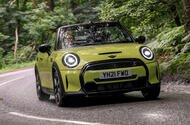
A stylish drop-top that’s fun to drive and easy to live with? No-brainer – but get in before winter
Eyeing a convertible for summer? You won’t find a lot on the new car market: waning profit margins for niche models and the popularity of crossovers mean the drop-top market has… dropped off.
A few stalwarts soldier on, such as the Mini Convertible. But with prices nearing £30,000, why not consider its predecessor, which you can now pick up from about £3000?
When the fourth-generation Mini arrived in 2014, it proved to be the most mature yet. The doe-eyed face, posh chrome detailing and bulbous retro lights cloaked a deeply modern ‘UKL’ architecture from the BMW Group, Mini’s parent.
It is a little larger than its predecessor, at 3.8m long and 1.7m wide, a lot more refined and more substantial in its feel. This is true of all variants but is felt most acutely in the Convertible as its new roof is far more thermally efficient and quieter than the Mk3’s. With it up, you’re hard-pressed to tell it is fabric over your head, rather than metal. The roof folds into a neat pile atop the derrière in only 18 seconds and up to vehicle speeds of 19mph too.
Step inside and you’re greeted by a different layout from that of past Minis. Instead of a speedo in the middle, a small cluster of dials (or an elliptical screen from 2021 onwards) sits behind the wheel. A head-up display was a reasonably common option when new too.
Replacing the central speedo is a circular bezel with integrated ambient lighting to match the selected drive mode, and a 6.5in infotainment screen with rounded edges or an 8.8in screen as an option (standard after 2021).
The rear only really has space for kids, but even that’s a win because two-row drop-tops are few and far between. A saloon-style bootlid means the boot isn’t as practical as a Cooper hatchback’s, but its 215-litre capacity is decent enough for a couple on a weekend away.
On the move, there’s little dynamic sacrifice in opting for the Convertible. True, it’s 115kg heavier than a three-door tin-top, but it still moves with 95% of the enthusiasm, the suspension staying firm but well damped and the steering direct. It’s a bit of a stretch to say it has the clichéd ‘go-kart feel’, but it certainly offers more charisma and fun than most alternatives, resisting the chassis flex and scuttle shake that sometimes blight the open-roof driving experience.
It’s eminently drivable in town too. Rear visibility is decent and standard rear parking sensors further aid easy manoeuvring.
The engine line-up consists of three petrols, a diesel and an EV. We’d stick with petrol. The diesel is very economical (60mpg isn’t hard) and yearly tax is just £20, but an oil-burner’s rattle just doesn’t suit the romance of open-air motoring. The EV is extremely rare (only 199 came to the UK) and the 100-mile real-world range isn’t very useful.
The 134bhp Cooper, 189bhp Cooper S and 228bhp John Cooper Works (JCW) are more numerous and their petrol engines are better suited to the car’s fizzy personality. The 1.5-litre Cooper is adequately powerful and economical (50mpg is in reach) while the 2.0-litre Cooper S suits a more sporting demeanour. The JCW isn’t significantly faster, but it is quite a lot less comfy.
Both the six-speed manual and eight-speed auto (or seven-speed DCT after 2018) are enjoyable to rub along with-as, indeed, is the open-air Mini experience as a whole. It’s the kind of drop-top you might buy with summer in mind and then end up using all year round.
What we said then
6 April 2016: “BMW could have got away with phoning one in with this car-but it hasn’t. The Mini Convertible feels like a much better-engineered car than it needs to be, one of integrity and attention to detail, improved significantly over the car it replaces.”
An owner’s view
Sharon Knight: “I’ve had my Mini Cooper Convertible for three years after buying it through the approved used scheme. I really enjoy how it drives, especially with the top down, and appreciate how much smaller it is than most other convertibles. All it’s cost me so far is routine servicing and brake pads.”
Buyer beware…
Engine: Be wary of Cooper S models built between 2014 and 2015, because a recall was issued to repair a defective crankshaft bearing and engines were either rebuilt or replaced. Check that the whole engine has been replaced because other parts may have been damaged by the faulty crankshaft. High oil consumption is common on the more performance-focused models so check oil levels and make sure the car is serviced every year.
Exhaust: Ensure the Pro exhaust on the John Cooper Works cars is fitted properly. You’ll know if it isn’t because the heat shield underneath the car will rattle.
Suspension: Listen out for a knocking noise from the front suspension because the control arm bushings like to make a racket when they’re worn. A new bushing is around £30, plus fitting.
Body: Door seal rubber can rub away the paint on the inside. You can buy door-shut paint protection film to stop the issue from recurring. Also check for clouding in the wing mirrors. New glass is around £20.
Roof: Ensure it operates smoothly and quickly. They don’t commonly fail, but if they do, repair bills could be in the thousands. The optional wind deflector is a must-have, but easily available online.
Water leaks: Again, not a common issue, but if the roof is not sealing properly and letting water in, there is the potential for big bills.
Interior: Don’t be surprised if the dashboard trim rattles, especially on higher-mileage cars.
Also worth knowing
Wired Apple CarPlay and Android Auto were added as an option in 2018 (look for the widescreen nav) but can be retrofitted on earlier models.
Options push up the price of used examples. The Harman Kardon sound system and leather seats are particularly desirable.
Trim designations weren’t added until 2018, and even then the Classic, Exclusive and Sport packages could still be loaded up with options.
Power dropped a little in 2021 for the Cooper S (to 176bhp) but you’d be hard-pressed to notice.
Insurance is reasonable, with groups ranging from 11 to 33.
How much to spend
£3000-£6999: High-mileage cars (mostly wearing it well). Lower-spec Coopers and Cooper Ds with fewer than 100k miles too.
£7000-£9999: Early cars, with Cooper Ss and JCWs available at a four-figure premium.
£10,000-£14,999: Desirable 2018 facelifted cars with the Union flag rear lights.
£15,000-£30,000: 2021-facelift models with the larger touchscreen and digital dials. Low-mileage two or three-year-old cars still command nearly new prices.
One we found
Mini Cooper Exclusive Convertible, 2019, 40,000 miles, £12,895: This smart-looking car comes in a desirable spec with the right options and has the 134bhp 1.5 petrol. It’s also got a full service history and a 12-month MOT.