Racing cars covered in corporate logos are dull; bold, creative art cars are what truly capture fans’ imaginations
One appealing aspect of car culture is that, whether mechanically or through design, vehicles can be used to express individuality and creativity. And, when it comes to the cosmetic side of things, to me there’s no better expression of that than the ‘art car’.
My favourite art cars are those found within motorsport, where standing out for maximum visibility is one of the main aims of the game – second only, perhaps, to winning.
Yes, motorsport liveries are usually intended to accommodate sponsors, which play an essential role in financing a team, but they can also allow a car to draw the eye on a grid of a dozen or more other similar shapes, which could ultimately be the difference in gaining supporters.
They also allow teams to show some creativity in circumstances where restrictive regulations usually mean they’re either unable to or can only do so in areas that the casual fan will never fully appreciate.
A good livery can give a car an extra layer of identity, and the best examples have the ability to stay in the memory of fans and spectators for much longer than where the car finished in a race, or even the name of the driver at its helm.
Because they’re rare, art car liveries always feel a little more special, a point of difference on the grid, and usually do a better job than anything else of winning the hearts of the spectators.
Many of them even abandon big title sponsors – and the financial benefits they bring – to ensure the livery isn’t dictated by logos or brand names. Their only purpose is to make a statement and put smiles on the faces of the fans,which you have to admire.
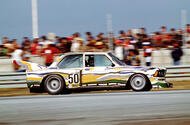
BMW is the undisputed king of the art car. For 50 years the Munich brand has been associated with liveries dreamed up by artists, from the 1975 3.0 CSL by Alexander Calder and the 1977 Roy Lichtenstein 320i Group 5, to the 1979 Andy Warhol M1 Procar and, most recently, the M Hybrid V8 hypercar designed by Julie Mehretu for the 2024 Le Mans 24 Hours.
The Jeff Koons M3 GT2 from 2010 is still my personal favourite, with its many multicoloured ribbons. The lineage currently stands at 20 art cars that punctuate BMW’s motorsport history, as well as a few road cars, and I hope that number continues to grow into the future.
The motion of an art car is still pleasingly called upon by others, too, as displayed by the fantastic HWA 190E Evo R that recently raced in the Nürburgring 24 Hours, featuring an awesome glow-in-the-dark livery by Hanna Schönwald that came alive after the circuit was plunged into darkness for the night stint.
That colourful faux-Mercedes received plenty of attention, which isn’t much of a surprise: my love for art cars is clearly shared by plenty of others, and I think the motorsport world wouldn’t be quite as fun without them.