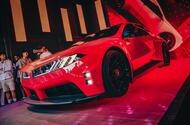
New electric version of super-saloon prioritises driver engagement rather than more power, says M division boss
BMW is producing its “own natural enemy” in the electric M3, according to M division boss Frank van Meel, as buyers of the next-generation M3 will be lured away from the petrol variant by the EV’s superior dynamics.
The M3 EV was previewed by last month’s unveiling of the M Concept Neue Klasse. This represents a total transformation of the forthcoming i3 electric saloon, with its muscular design drawing on the M division’s sporting heritage.
But it will also be sold alongside a new combustion-engined generation of the stalwart super-saloon, which was recently caught testing for the first time.
Its turbocharged 3.0-litre straight six has been updated to meet the Euro 7 emissions requirement without any loss of power from the current 503bhp.
Speaking to Autocar at the Goodwood Festival of Speed, van Meel said: “Now we are fighting against [ourselves], because with the all-electric M3 we are attacking our best-selling product – the leader in its segment.
“We are also working on a future generation of [petrol] M3, but now we have an internal fight. We are just pushing ourselves with the two different powertrains, and it’s a great contest.”
Key to the electric M3’s engineering brief is that it will have four motors – but it won’t simply chase headline power and torque outputs, instead using the unusual arrangement to bolster its poise and agility in pursuit of heightened driver engagement.
“It’s not about having even more power,” emphasised van Meel. “At the end of the day, you can’t put that down to the road anyway. You need to have sufficient power at every corner of the car and we are using four electric motors, but you will never use it at the same time.”
The BMW Vision Driving Experience prototype (pictured above), which previewed the technical capabilities of future M cars, had a four-figure power output, but van Meel said drivers “don’t need 1000 horsepower” on the road.
“It’s like a kickboxer. You never kick with two legs. You can have strong arms and strong legs, but you don’t use them all at the same time. And it’s the same with four electric motors.”
The M division is instead looking to unlock the dynamic benefit brought by having four motors controlled by a central computer, referred to as the Heart of Joy.
“It’s insane what you can do with that technology,” said van Meel. “You can bring more agility or stability to the car. You can brake the inner wheels, accelerate the outer ones and can get out of turns in a completely different way. It’s a new era of vehicle dynamics.”
He continued: “Power is nothing without control. Of course you need a lot of power [in a performance car], but you also have to control power. If you just throw out a huge amount, you will just leave four stripes on the Tarmac. In the best case it’s still stable but actually makes no sense.”
Van Meel is confident that the new capabilities brought by the quad-motor powertrain will win over buyers in the battle between the ICE and electric M3s.
He said: “There might be customers who say they want to have a combustion engine because they like the sound or the looks or cannot charge at home. That’s fully okay. But if you’re into racing or driving dynamics, you might say the electric one is the best M3.”
Van Meel joked that “in case of doubt, [customers can] buy both” but added that BMW will target both versions of the M3 at the same people and “the customer can decide”.
As previously reported by Autocar, the M3 EV will also offer simulated gearchanges, but that will no longer be paired with a simulated engine note inspired by historic M cars, said van Meel.
“We tried all the different sounds: we had a high-revving V10 from the M5 (pictured above); a high-revving V8 from the M3; we even tried the four-cylinder from the E30. But every sound only made sense for that specific car. If you try to put the sound in another car, the feeling is not right.”
The M division will instead develop a new sound inspired by the electric motors – but this, said van Meel, “shouldn’t be any Captain Kirk spaceship sound, because then you’re not connected”.
He said the dilemma is “philosophical” and that the M division is trying to “move ahead” in replicating the “feeling” and “emotion” of an ICE car, rather than directly copying its character.
More broadly, van Meel said the decision to simulate the power delivery of a combustion engine and gearbox is intended to make driving an electric M3 more intuitive.
“If you’re on the track, you want to know how quick you are. You need to have some pedal feel and ratios that you are comfortable with, so that you automatically know you are driving [for example] 100mph because you are in third gear, because you know the deceleration and acceleration. That’s what you want.
“You can of course copy a gearbox, and it’s already quite emotional. That’s a good idea. But we want more.”
Design reinvention
Fundamental to the design of the next M3 is “proportion”, said M division designer Michael Scully, guiding Autocar around the M concept.
“When we look at the new powertrain there are a very different set of considerations packaging-wise, and we have worked very hard to get the proportions to what our customers expect – that very classic two and a half boxes with a very agile, dynamic [stance].
“To find a proportion that works for us is the first order of business, and we have a chance to take it one step further in terms of boldness.”
Scully also hinted at a cleaner, less fussy look for future M cars. “We are reducing them down to really the performance essence of the car. There’s a reductionism which, if done intelligently, means you can get it down to what is truly necessary from a performance standpoint.
“That’s really important in racing, and we’re now approaching it the same way in our production models.”
Scully described the fresh approach as “intelligent reduction”, as “whenever it turns into a decorative area, I don’t think that’s a good thing”.
Asked if that meant a move away from the large grilles and aggressive flares on current M cars, he explained: “Intelligent reduction is important, but it’s also about emphasising functional elements.
“What’s really important is that the elements we do have – from an aerodynamic perspective – is the real stuff, it’s not implied. That’s where the authenticity comes from. Our customers have incredibly educated eyes and they can see if we [jump the shark] on performance.
“It’s also important to embrace the new powertrain. For example, we’ve got four electric motors, one on each corner, so let’s pronounce that. It helps make the cars look muscular and strong but it also pronounces where the powertrain is.”
Scully drew on his experience shaping BMW’s race cars in devising the new M3.
One example of his new, more purposeful approach is the massive double-decker diffuser mounted at the rear of the M Concept Neue Klasse.
This, Scully explained, was inspired by the racing M3s fielded in the GT2 and GT3 classes over the years. Those cars trade a traditional exhaust for side-exit systems, opening up space for a more aggressive rear diffuser, needed to generate downforce on track.
Replicating this design on the road-going M cars of the past wouldn’t have been possible, lest drivers or passengers burn their legs on entry or exit after a spirited drive. But when you dispense of an engine in its entirety, and therefore also an exhaust, that frees up room for such an aerodynamic package.
“We don’t have that [exhaust] requirement, so let’s open it up and celebrate the opportunity that we have now,” said Scully.
“We have a double-decker layout for the diffuser with a main [section] and an aerofoil across the bottom. The floating aerofoil helps to manage the flow. With aerodynamics, there’s never one standalone element: it’s always a constellation of things that affect each other.
“For example, that diffuser interacts significantly with the duck-tail spoiler, so that’s a constellation; that’s where a lot of downforce comes.
“I love downforce, because that’s the thing that, from a driving sensation standpoint, allows you to do things which your intuition says you can’t.
“When a car does that, when it enables the driver to experience those things their intuition tells them is impossible, I think we’ve landed in a great space.”
Indeed, prototypes of the next combustion-engined M3 have revealed a smaller rear diffuser than their electric counterparts, owing to the presence of M’s signature quad-tip exhaust.
Scully also highlighted the large, deep vent in the concept’s raked bonnet. This is used to cool the four motors’ front-mounted radiator, but such a prominent feature would not have been possible were it not electric.
“Normally you would have a big engine right there and there’s no way you could have those ducts, but here we can,” he said.
Notably, the M concept dispenses with the hook-like side mirrors that have been a fixture of the M3 since the E36 generation.
This, said Scully, is another manifestation of motorsport-inspired design: “M customers over the years have come to know and love the cars for having this hook that points back toward the centreline of the car. But what we discovered was that if we turn the fin vertically, it’s actually more efficient and brings small gains.”
Meanwhile, the car’s main-beam lights are mounted low and wide on the M Concept’s flanks. These are inspired by the M Hybrid V8, the BMW hypercar that raced in last month’s 24 Hours of Le Mans.
Meanwhile, the yellow positional lights – previously exclusive to the rare-groove CS versions of the M3 and M5, plus the M4 CSL – reference the headlamp colour cars are mandated to use in the American GTD racing class.
Although the M Concept exploits BMW’s sporting heritage, the company does not currently build an electric race car.
Asked whether there is a dissonance between drawing on ICE cars for the design of an EV, Scully said: “I don’t think it makes it more difficult; it makes it more meaningful.
“I think the reason this car resonates is that people can see we embrace our heritage with motorsport and our ongoing involvement with it and are able to translate it into an electrified future.”