Super-saloon will be offered with both electric and combustion power – and a manual is still on the cards
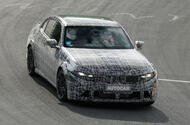
The combustion-engined version of the next-generation BMW M3 has surfaced in tests at the Nürburgring – and the super-saloon could continue to offer a manual gearbox.
Speaking to Autocar at last week’s Goodwood Festival of Speed, BMW M boss Frank van Meel said the division’s petrol performance cars will offer manuals for “as long as possible”.
He highlighted that sales of the smaller M2 coupé in the US – a market traditionally dominated by automatic gearboxes – are actually split 50:50 between autos and manuals.
He also pointed to the engagement fostered by rowing your own gears: “We want to have this mechanical connection, shifting by yourself. It’s an emotional thing, it’s not just an engineering thing, and it’s still there.”
But offering a stick shift in a mainstream car is becoming harder, van Meel added: “The supplier base is getting smaller, and with all the driver assist systems it’s getting more difficult to disconnect the drivetrain. Then you’re disconnected from your driving assistance system as well as all the mild hybridisation systems.”
Yet this “doesn’t mean it isn’t possible”, he said, adding: “We intend to keep the manual as long as possible.”
M3 keeps its signature straight six
In either case, key to the appeal of the next combustion-engined M3 will be the retention of its turbocharged 3.0-litre petrol straight six.
This diverges from the path followed by BMW’s German rivals: the Audi RS5 kept the RS4‘s 2.9-litre V6 but added plug-in-hybrid hardware, while the Mercedes-AMG C63 moved from a V8 to a four-cylinder PHEV system.
BMW’s ‘S58’ engine, also used in the M2 and M4 coupés, was recently updated to meet the Euro 7 emissions standard in a significant engineering effort.
It was redeveloped for pre-chamber combustion, in which a small amount of fuel is detonated in a small space just before the fuel reaches the main cylinder. This creates a highly energised ‘jet’ that then lights the fuel in the main chamber.
This, BMW claims, is much quicker than a traditional spark plug, which brings several benefits. Chief among them is increased greater energy efficiency, and therefore greater fuel efficiency, which reduces emissions.
Van Meel told Autocar last year: “The whole story is about driving with lambda one [when the air-fuel ratio for combustion is perfectly matched], so you have to keep that. And there’s no cooling; normally, if you are in high-performance situations, you cool using the fuel. With Euro 7 that’s impossible, so you need to find different ways of avoiding temperature build-up.”
The new combustion process also helps to alleviate premature fuel detonations (knock), which allows it to be run at a higher compression ratio, thereby boosting power.
The updated engine also gets new variable-geometry turbochargers.
These measures meant BMW could mitigate any loss of power from adjustments made to meet the requirements of Euro 7 – and the firm claims they also create a throatier induction and exhaust sound at high revs.
BMW has previously confirmed that “power outputs will be unchanged from those of the corresponding outgoing engines”. For reference, the current M3 puts out 523bhp and 479lb ft of torque.
Speaking to Autocar last week, van Meel said: “We’re leading with the M3 today and we’re not going to give that up. That’s why we first said [at the start of the development programme] that we’re going to bring the current engine to the EU7 level; then that’s already done.
“If we look into the next-generation M3, we already have the drivetrain. The engines are already there, and we are of course already working on the combustion-engined M3 as well; that’s in the books.”
Van Meel added that he is “confident we can keep up the power” but highlighted cooling as an issue brought by the new engines: “If you go on track, of course, temperature is an issue. We improved cooling to counteract; the challenge with the big engines and the big coolers that they need to be even stronger.”
This manifests in the large open grille at the front end of the next combustion-engined M3, behind which a large intercooler is stashed.
Asked by Autocar whether there is still potential to improve ICE performance cars, in light of tightening regulation and investment being diverted to electrification programmes, van Meel answered: “Yes.”
Choice of ICE or EV is key
Although the petrol and electric derivatives of the next M3 will be based on different architectures, effectively making them two completely distinct cars, the ICE car will have the same styling as the EV.
The design of both cars was previewed with the recent M Concept Neue Klasse. Key differences include the large front grille but also a smaller rear diffuser.
The electric M3 will take advantage of the lack of an exhaust by maximising the size of its underbody aerodynamics, but this will not be possible for the ICE car, which retains a quad-tip exhaust.
Van Meel pointed to the updated engine as an example of how M will negotiate the years to come and said it’s important to offer customers a choice between combustion engines and EVs.
He elaborated: “There might be customers who say ‘I want to have a combustion engine because I like the sound or the exterior or I cannot charge’. That’s fully okay. If you are into racing or driving dynamics, you might [prefer] the electric one. I always say in case of doubt, buy both: the combustion-engined one and the electric one, and then you can make a new choice every day.
“But the customers [for both versions] will actually be the same, and they can choose like they can today: they can choose if they buy an M2, M3, M4 or an M Performance model. Now they can choose: ‘Do I want to drive electric or combustion?’ We promise the way the car drives and the way it makes you feel is always there.
“We bring this decision-making process to the customer, not to us. We just want our offering and the customer can decide.”
To that end, BMW M sales boss Sylvia Neubauer recently told Autocar the ICE M3 will be priced in the “same ballpark” as the EV.
“Obviously we will not convince 100% out of the petrolhead target group to buy an all electric BMW M3,” she said. “But out of 100 people that try it, we will be able to convince some. And for everybody else, we will still provide combustion engines.”
Neubauer added: “There will be functional differences that lead to a different design in some areas of the car, but when you look at them, you will see that they are twins.”
M3 Touring to return
The Touring estate is expected to remain part of the M3 line-up.
“The M3 Touring is one of the best models that we have in our portfolio,” said Neubauer.
She added that it had been an unexpected success in China, while the larger M5 Touring had exceeded sales expectations in the US. Neither market had typically been big on BMW’s estates.
Indeed, the M3 Touring is the only way to buy a 3 Series Touring in China.