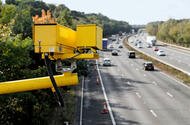
Deterrents – such as bright yellow cameras or traffic police – could be a more effective measure
Executive director of Parliamentary Advisory Council for Transport Safety suggests drivers are becoming complacent
Fines for driving offences should be increased to fund a rollout of Al-powered traffic cameras across the UK, the head of a leading transport safety charity has told Autocar.
Jamie Hassall, executive director of the Parliamentary Advisory Council for Transport Safety, claimed this will quash a belief among a growing number of drivers that they are unlikely to be caught speeding or driving dangerously.
The latest generation of Al traffic cameras feature high-resolution imaging and ultra-fast processors that can detect if a driver is speeding, using their phone or not wearing a seatbelt. They can also automatically check all UK police and DVLA databases to check whether a vehicle is taxed and insured.
Around 200,000 drivers are found guilty of speed limit offences each year. Last year, almost five million penalty points were issued for driving offences, more than three-quarters of those for speeding.
To address this, Hassall recommends that fines are increased to help fund more speed cameras and Al cameras.
“Penalty points are a useful tool, but we need to increase the probability of bad drivers being caught,” he said.
“One way would be to increase fines for moving traffic offences from £100 to £500, using the money raised to fund more cameras and Al technology, in addition to police patrols and improved intelligence around drivers such as serial parking offenders, who are often dangerous drivers.
“You can get fined £150 for dropping litter, but no one dies. Speed awareness courses are useful, but second-time offenders deserve a much higher penalty.”
Meanwhile, a new survey of drivers has found that fewer than half of motorists believe penalty points discourage dangerous driving.
However, the survey, by USwitch, also found that among those drivers who had been given points, four out of five changed their driving behaviour to avoid accumulating more.
Commenting on the findings, James Gibson, executive director of charity Road Safety GB, said: “Penalty points are useful but not sufficient on their own. Evidence around deterrence of offending highlights increased visibility of enforcement to be important. This is based on research that shows the perceived likelihood of getting caught is a stronger deterrent than the severity of consequence if caught.”
Plan for overhaul of penalty points
While the government has yet to announce plans to raise driving fines, it is looking to deter law-breaking motorists in other ways.
In a bid to lower road death numbers, which have plateaued since 2010, it wants to increase and more effectively use penalty points, as well as to introduce new offences.
A spokesperson said: “We know that the majority of motorists are responsible and law-abiding, but they and other road users want to see law-breaking dealt with, to make all our communities safer.”
Further revisions are also being weighed up, with the proposed key changes as follows:
Seatbelts: Non-compliance to go from a £100 on-the-spot fine to accruing three penalty points.
Registration: Points for driving a car with no registered keeper, no MOT or an incorrect numberplate.
Impaired driving: Combining drink-and drug-driving offences, with lower limits.
Driving uninsured: An increase from the current six penalty points if caught driving without or with improper insurance.