Close to 1500 cars were on display at Auto China 2026. What we get in the UK only scratches the surface
The Beijing motor show is vast. The basic stats are mind-bending: the show spanned 17 exhibition halls that stretched for 1.2km, with close to 1500 vehicles on display.
Over the two press days, 181 brand new models were launched, along with 71 concept cars. Well, that’s what the organisers claim, at least: I’m afraid that, despite my best efforts and diligence, I doubt I could have actually checked out every new machine.
Besides, even those numbers don’t really convey the scale of the show. Since Auto China was last held in Beijing two years ago (it alternates annually with Shanghai), an entirely new and larger convention centre was built and opened next door to the China International Exhibition Centre. So, like Field of Dreams with neon-lit show halls replacing corn fields, the show simply expanded to fill both venues.
The dramatic architecture and scale of the new exhibition centre wasn’t the only showcase of Chinese ambition: the grandiose displays and unveilings by the homegrown firms inside the show halls showed matching scale and ambition.
Chinese firms have long stopped trying to emulate Western car giants. Their confidence is shown in their increasingly aggressive global expansion plans – especially to markets with few tariff barriers, such as the UK – and their technological development. It makes sense: part of the reason the Chinese government has pushed the development of the automotive industry in recent years is because of how it can fuel whole other sectors of the economy.
Electric cars require batteries, motors, semiconductors, infotainment chips, AI systems and more – and the Chinese car firms, many of which have expanded into automotive from other industries, are bringing vast swathes of that in-house. Leapmotor, for example, says its produces 65% of the parts that go into its cars. Such vertical integration is a key part of achieving ‘China speed’ model development times of under two years and part of the reason these firms can grow so quickly.
At its pomp, the Frankfurt motor show was known for its vast, unwieldy scale, but even that pales in comparison to Beijing. And just as Frankfurt’s size was driven by the big German firms all trying to outdo each other with ever bigger and grander show stands, so Beijing’s growth is driven by the big Chinese players all trying to outdo each other – but with the twist that established global rivals, after a few years being firmly overshadowed, are now aggressively fighting back.
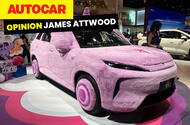
BYD, along with its various sub-brands, filled an entire exhibition hall by itself. Well, how else was it going to find room to display the BYD Ocean V MPV concept (pictured below), Denza Z GT convertible, carbonfibre-bodied Formula X roadster from its Fangchengbao premium brand and a unicorn-horned Yuan Plus coated in pink fur, part of a collaboration with My Little Pony?
BYD’s rapidly growing roster of brands – which also includes luxury Yangwang and ride-hailing firm Linghui – exemplifies one of the big trends of the Chinese industry in the last few years. As the market continues to grow and develop, so the big firms have started expanding their roster of brands, meeting the growing segments created as the Chinese car market grows and matures.
Western car giants have done that for decades, of course, but the likes of General Motors, the Volkswagen Group and Stellantis grew their brand rosters from acquisitions, mergers and consolidations over decades. The Chinese are trying to build their own families at record speed through imagination and willpower. So while some firms have bought up established brands (such as Geely with Volvo, Lotus and Proton or SAIC with MG and Roewe, which grew out of Rover), many – such as BYD’s growing family – are simply being created to service every conceivable niche.
But for a visitor from the UK admiring a vast number of similarly styled machines, it’s hard to really know which segment any particular brand is aiming for. What’s the relationship between Nio, Onvo and Firefly? Which markets are Zeekr and Lynk&Co targeting? Is an Aito as posh as a Luxeed? Their designs offer little clue.
Clearly, as Chinese brands continue to enter the UK market, brands such as BYD, Leapmotor, Geely, Jaecoo and others become recognisable. But even that isn’t simple: Deepal is a standalone brand in China, but its cars are sold in the UK with parent firm Changan’s badge on. Denza’s UK line-up will include rebadged Fangchengbao models. And there remain brands that are just plain mysteries. Dreame or Voyah, anyone?
Since you were wondering, Dreame is a vacuum cleaner manufacturer that has branched out into cars with the 1903bhp Next 01 saloon because, sure, why not? Meanwhile, Voyah is Dongfeng’s premium brand and has just launched the 5.2m-long X8 SUV.
Trying to identify all these brands is made harder because many of their logos and models remain somewhat indistinct. The days of blatant rip-offs of Western models are long gone (although you’ll find more than a few electric saloons that owe a nod to the Porsche Taycan), but China’s saloons, SUVs and MPVs all tend to coalesce around fairly familiar and somewhat amorphous designs.
The big trend in the Chinese market at the moment is big cars: there’s a growing number of three-row SUVs and large, upmarket MPVs. Sadly, that’s come at the expense of some of the quirk: there were sadly few tiny electric city cars such as the Wuling Hongguang Mini EV on display.
But there were still bizarre sights. There was that My Little Pony-themed BYD, for one, and the firm also had several models including a Seal 06 GT Black Myth carrying designs promoting the video game Black Myth: Wukong. Leapmotor, meanwhile, had examples of its D19 SUV promoting partnerships with McDonald’s (in China you can actually order a burger through a car infotainment system) and Beijing Zoo, complete with giant stuffed panda. And yes, humanoid robots were very much in evidence.
Fast food-based infotainment apps are just one example of how Chinese buyers continue to flock to technology. Big screens are still very much in vogue in China, you’ll see plenty of cars with glowing lights indicating they’re running in semi-autonomous mode and several firms are showcasing chargers that can reach rates of up to 1500kW.
But don’t think the Chinese went unchallenged at the show: long-established global brands were much in evidence. In fact, after a few years post-Covid when they were firmly overshadowed at Auto China, there was a confidence that, after years of trying to catch up on technology, they now have products to take on the Chinese.
BMW’s stand was dominated by examples of the iX3 SUV, which sits on the firm’s advanced Neue Klasse platform, along with the heavily updated 7 Series and i7 saloon. Mercedes, meanwhile, was also pushing its next-generation GLC SUV. They’re sticking with their own in-house platforms and software, although they work with locals partners to offer infotainment better suited for China.
Notably, these brands were also drawing heavily on their heritage: Mercedes is celebrating 140 years of the combustion engine this year and had its first-ever car on display, while Porsche’s stand features the new electric Cayenne Coupé alongside classics such as the 356. Mini showcased a wide range of customisation concepts and built on its British roots with a Union Jack-liveried car.
Such heritage is something Chinese firms simply can’t match. Well, unless you count the likes of SAIC-owned MG leaning on its famous badge with ‘Morris Garages’ signage and a show car sporting more than a passing resemblance to a Metro 6R4. Or Chery buying the rights to the Freelander name from JLR and reviving it as a new SUV brand.
Notably, though, the relationship between Chinese and established firms has shifted: it’s now frequently the Chinese firm taking the engineering lead on joint ventures in the market. For example, Leapmotor sells its models internationally through a joint venture with Stellantis. Or there’s Smart, now a joint venture between Geely and Mercedes-Benz, with Germany leading the designs and China providing the tech. The firm’s big show star was perhaps the smallest car there: a #2 concept reviving the spirit of the original Smart car.
Meanwhile, Peugeot unveiled two dramatic concept cars at the show, although both were sat on platforms developed by joint-venture partner Dongfeng. And while the Volkswagen Group is still leading development for its joint venture partners, such is the technology divergence in the country that it has developed its own China-only architecture, the early fruits of which were rolled out in Beijing.
But the Volkswagen Group still has heritage, which is reflected in the new brands its launching to fill the various market segments. The Jetta has been turned into an entry-level brand, while Audi is trying to reach a new segment of customers with its own offshoot, curiously called AUDI. Seeing the four-ringed and four-letter Audi brands next to each other was confusing, but execs it makes sense in terms of addressing different market segments.
But that’s the Chinese car market and the Beijing show: vast in scale, ever-changing and extremely confusing yet also utterly fascinating. It offers glimpses into the future of the industry and the ridiculous ambition of Chinese firms but also shows how established car giants are reacting to and learning from them.
Chinese car firms have gone global, but what’s reached the UK so far is only scratching the surface of their capability and ambition. Trust me, I’ve walked through the 18 exhibition halls that prove it.