Coachbuild Collection ushers in new era, with Nightingale to influence future Rolls-Royce models
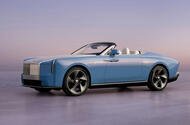
The new Rolls-Royce Project Nightingale, a limited-run electric convertible, is the first in a new range of ultra-exclusive models from the Goodwood-based firm that, it says, will spark a change in how it designs cars forever.
The 100 examples of the new two-seater will be the first products of Rolls’ new Coachbuild Collection. Each of the 100 EVs will be priced from around £7 million but the final cost is likely to be significantly higher due to extensive customisation.
Rolls plans to launch a range of limited-run cars with bespoke designs and a high level of personalisation options under the Coachbuild Collection banner, with new arrivals every two to three years.
The Coachbuild Collection models will sit between the series-production one-offs, such as last year’s Phantom Goldfinger, and the ultra-exclusive full Coachbuild models, such as 2021’s three-off £20m Boat Tail.
All of the Project Nightingale models – not the car’s final name – are already accounted for, with owners chosen by the firm.
“We’re only talking to our best clients here,” said head of future products Phil Harnett. “We want to find proper homes for them, with the people who appreciate this and want to drive them. We are making sure every single one of those clients is the right person and they are people who are going to hold on to that car.”
Testing of the new model will begin this summer ahead of first deliveries in 2028. Although it is still a concept, Rolls claims Project Nightingale is 99% production ready.
The drop-top is a modern-day interpretation of the 17EX Torpedo, a streamlined touring coachwork test chassis of the 1928 Phantom I. Like that car, much of its length (at 5.76m the new car is as long as the flagship Phantom) is devoted to the long tail.
The design also points to a refreshed look for the brand under the direction of former BMW design boss Domagoj Dukec, who moved within the BMW Group to join Rolls in 2024. “It will shape everything that follows,” he said.
While the model is based on the same Art of Luxury platform as the rest of the brand’s range, Rolls says most of its parts are unique and insists that it shares little with the smaller Spectre, the company’s first electric car.
Coachbuild-lite
Harnett said the Coachbuild Collection was driven by customers who wanted a bespoke Rolls but “didn’t have the time” needed to become immersed in the full Coachbuild programme.
The project also gives Rolls’ designers the freedom to create experimental and “extravagant” elements and features that will later trickle down to shape the design of higher-volume models.
Crucially, it will be a significant revenue driver for the firm, which sold 5664 cars last year. The heavy personalisation means these models should offer higher margins.
“We’ve been wanting to do more,” said Harnett, “from the sales side to designers. They are always sketching something. When you go to our design offices, you’ll always see pictures of extravagant things which we want to do.
“Then, talking to our clients, some people want to do a Coachbuild but they don’t necessarily have all that time they need to invest – you’re talking to the clients all the time: come in again; come in again; come in again. They also [said] they wanted to be led by us: ‘Could you do it for me? I’m paying you. You do the work.’ They want us to deliver something.
“So it’s these discussions, and we’ve been looking to see when the time is right. And then it just organically came that we said: ‘We’re ready now to do it.’”
Harnett said the project works in a “revolutionary” fashion: instead of showing prospective owners the finished cars, Rolls brings them in at the sketch stage, so they are part of the process, but without needing the level of input required for a full ultra-exclusive Coachbuild car.
“We’re doing something a bit back to front,” he said. ”We are taking our clients on a journey with us.” They will even be invited to take part in the car’s global testing programme at certain points.
“Everything we have done with this is different and that is exciting,” said Harnett. “This is a new chapter for Rolls-Royce: we have rejuvenated coachbuilding so that it is relevant again. Now we are revolutionising it again.”
Key for the Coachbuild Collection is to create cars that won’t just sit in garages, which is why the first car is a convertible. Harnett said: “This is not a show car. This is a car to drive.”
The production version of Project Nightingale has been sold to clients in the US, Europe and Asia in both left- and right-hand-drive guises. The range of owners is “diverse”, said Harnett, who added that “they are the real, real Rolls-Royce enthusiasts”.
While 100 examples of the car will be made, Harnett said future Coachbuild Collection projects could have production runs of varying sizes, although the aim is to keep them exclusive.
Unique design
Project Nightingale’s name is derived from Le Rossignol – French for ‘the nightingale’ – which was the name of a house used by Rolls designers, situated near co-founder Henry Royce’s winter estate on the Côte d’Azur in southern France.
The project was led by Coachbuild designer Jacobo Dominguez Ojea, a BMW Group stalwart of more than two decades who has previously worked on the exteriors of cars including the current-generation BMW 3 Series and 8 Series Gran Coupé.
“We realised very early on in the project that this was a once-in-a-lifetime model for Rolls-Royce,” he said.
Talking about taking design inspiration from the 17EX Torpedo, especially its long boat tail, he said: “We found that fascinating. The proportions: it had a very small cabin and this long tail, but of course [for Project Nightingale] we wanted to do something clearly modern, very bold and pure in its shape.”
He added: “From a side view, you see the presence that it has. It’s unique. There’s nothing like it with these proportions. It’s the length of a Phantom that’s just for two people.”
Opting for a convertible also fitted the project’s aim of creating a car that is “not just to go from point A to point B, but the experience of driving this car is the destination in itself”, said Ojea. “This car is about the wind in your hair. It’s about the feeling of openness, to feel and hear what’s around you.”
The team considered offering it as a speedster without a roof but felt the addition of a cloth top makes it more usable. It also means it met the brief of being a car “that people want to drive and want to use”, according to Ojea.
He pointed to a number of new elements that are the most likely to be adopted by the firm’s future series-production cars, including its 24in alloys, a frameless ‘RR’ badge on the rear and flanks, near-metre-wide front grille and large rear transom diffuser.
Elements such as the 55mm-wide hand-built headlights integrated into the nose and the wild side-hinged bootlid are too labour-intensive to be used in a higher-volume car. But their looks could influence future designs, including the forthcoming electric SUV.
There are also new elements inside, including a centre armrest that is designed to resemble a horse saddle, and the familiar Starlight Headliner feature that, due to the car’s convertible brief, has been built into the doors and behind the seats. Ojea said it is “a bit like the stars have been blown around you”.
Technical details are not yet finalised, said Harnett, given the early stage of the development (“we’ve only briefly been in a wind tunnel”), but he confirmed it will use a bigger battery than the Spectre’s 107kWh lithium ion pack while offering “close to” the same 329-mile range.
Power details also remain undisclosed, but expect a dual-motor configuration with an output that is likely to match the Black Badge Spectre’s 650bhp.
Project Nightingale will be offered in nine exterior colours that are exclusive to the Coachbuild Collection, as well as seven different roof and 11 interior leather options.
Rolls CEO Chris Brownridge called Project Nightingale “our most ambitious work” and said it has brought “three things together that have never co-existed within our brand: the complete design freedom of coachbuilding; our powerful, near-silent all-electric powertrain; and a uniquely potent yet serene expression of open-top motoring”.