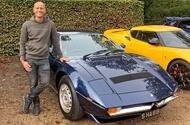
Merak SS is 50kg lighter than standard car and has three larger carburettors for its V6 engine
“When you’re a car enthusiast, you’re always looking around for your next purchase.” So says Shan Habib, but perhaps not even he could have believed what a corker of a car he eventually stumbled on.
“I have a Maserati Gransport and had always wanted a Merak,” he says. “Then this came along, advertised in the owners’ club…”
This is a Maserati Merak SS, sister car of the Bora but with a 3.0-litre V6 engine instead of the Bora’s 4.7 V8. Being the sportier SS version, it’s 50kg lighter than the standard Merak and has three larger carburettors plus a higher compression ratio, which together boost power from 185bhp to 215bhp.
The shorter V6 engine allowed Maserati to increase the car’s cabin space and make it a 2+2. It looks similar to the Bora but has a distinctive pair of buttresses extending from the rear screen to the engine deck.
It looks sensational. Shan agrees. “I love the shape of the Merak and that the car is so rare,” he says. “Maserati made only around 1000 Meraks, split almost evenly between right-and left-hand drive. Including mine, there are only around 30 right-hand-drive Meraks in the UK.”
The car was registered in 1977, but not long before Shan bought it, it was the subject of a 1000-hour body restoration.
“When I saw it, I didn’t think twice. I snapped it up. The body had been restored by Blackline Classic Cars. They did a beautiful job. It’s all metal; there’s no filler. The body sold me the car because they can be rust buckets. I paid £50,000 for the car. I reckon the bodyshop bill alone was that much,” he says.
A couple of years before the body was refurbished, the engine was overhauled when, among other improvements, it was fitted with sodium-filled valves. The suspension and brakes were also treated to a makeover. Really, only the interior of Shan’s car is completely original. “It’s why you noticed the authentic smell when you opened the door,” he laughs.
The Merak’s tyres are new but in the original style and remanufactured by Michelin with a modern compound. “Their tall profile helps cushion the ride,” says Shan. “In fact, although it’s almost 50 years old, the car is very nice to drive. It’s not supercar quick but gets away from the lights quickly and sits in motorway traffic at the same speed as everyone else.”
The Merak’s brakes are power-assisted and use Citroën’s hydraulic LHM system. “There’s no brake pedal travel,” says Shan. “Instead, the pedal feels solid. How hard you push it determines how well the system brakes. It takes getting used to, but once you get it, it’s fantastic.”
As for reliability, Shan’s Merak has barely put a foot wrong. The alternator belt snapped on the way to a show once, and after Shan changed the radio, a bad earth triggered starting problems. “That was easy to diagnose,” he says. “The car is quite simple, and with the right tools and some patience, it’s possible to fix almost anything.”
At least for the time being, Shan and his Merak are joined at the hip. “I think it’s a keeper,” he says. “Sure, I’d like a Ferrari from the 1970s such as a 512 BB or 365 BB but they’re in a different price category altogether!”