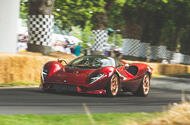
Project showed great promise but quickly unravelled under the pressure of building customer cars
“By all consideration, it’s a disaster.” Those words spoken De Tomaso owner Norman Choi in a New York court house in early February indicate what many in the business already suspected: that another revival of Alejandro de Tomaso’s infamous sports car brand is on the rocks without a single car being delivered.
The sports car business is famously tricky, and the bodies of the dead litter automotive history. So the odds of this De Tomaso revival bucking the trend following the brand’s flashy launch event at the 2019 Goodwood Festival of Speed were always going to be slim.
What you don’t usually get, however, is a blow-by-blow account of the difficulties of starting a sports car company from scratch and how it all went wrong. The successful court case brought by former De Tomaso CEO Ryan Berris against Choi over compensation after being sacked in 2022 has provided exactly that.
The revival was the dream of Choi, a Hong Kong-based car collector who provided the money.
In 2014, he had bought German supercar maker Gumpert out of bankruptcy, renamed it Apollo and commissioned Germany’s HWA to produce what would eventually be 10 track-only hypercars, selling for around €2.3 million (£2m) a pop.
In 2015, he then successfully bid for the De Tomaso name and intellectual property after it was put up by the Italian government following a previous failed revival.
This was a much grander venture. After toying with the idea of doing a straight replica of the Pantera, the hairy-chested 1970s sports car that was De Tomaso’s most famous model, Berris persuaded Choi to go upmarket.
The resulting P72 was the creation of a British designer, Jowyn Wong, who took inspiration from the P70 racer, a wild Carol Shelby-De Tomaso collaboration from the 1960s.
The impressive cherry-red show car, built around an Apollo Intensa Emozione, wowed Goodwood in 2019. The promise of precision engineering without the excessive complexity of modern machines also struck a chord.
Then came the hard bit. The exotic Apollo track car underpinnings would have to be ditched to create a road-going car with a promised price tag of €750,000 (£653,000). Months of slog lay ahead.
“There was still a lot of scepticism, because there’s a lot of people who try to start automotive companies or revive brands,” Berris told the court. “They’ll create a show car and many people refer to it [as] vaporware. It shows, it makes a big noise and then very few of them actually come to fruition.”
The plan was to lean on outside help rather than create a huge company. Berris told the writer of a cancelled book detailing the revival of De Tomaso that he intended for the company’s staff “to fit into a minivan”.
CFO Diana Majcher testified that “everyone wears multiple hats”, saying she oversaw not just finances but also “operations, admin, HR, contract drafting, legal matters, anything and everything. I scrub the toilet if I have to.”
Berris was hired after impressing at Scuderia Cameron Glickenhaus, a company set up to campaign a one-off Ferrari commissioned by wealthy American collector James Glickenhaus. Berris convinced them he could sell a road-going version. The Glickenhaus family were sceptical but Berris proved them wrong. “We couldn’t believe he had sold a car,” James’s son Jesse Glickenhaus testified at the trial.
Finding customers was a key job, and Berris had good connections in the wealthy US east-coast car scene. “The world is very small in these circles,” said Glickenhaus. “There is less than six degrees of separation from somebody who can buy your car to anybody else who could spend $2 million to buy a car.”
Berris was also in charge of marketing. In one coup, he fixed up a paparazzi-style photoshoot for the Mail Online in which Bernie Ecclestone, Christian Horner and Geri Halliwell were seeing nosing about a P72 prototype parked on the street in Switzerland.
This publicity didn’t come cheap. Berris’s decision to employ glamorous racer Carmen Jordá as an in-house influencer cost De Tomaso $250,000 (£184,000) a year, plus another $100,000 a year for her image rights.
Berris’s alleged closeness to Jordá and gift of a $19,000 Chanel suit became a key element of the trial as Choi defended his removal of Berris after a fallout over expenses in 2022.
Impressively, according to Berris’s testimonial, De Tomaso has taken between 40-50 deposits at $250,000 each for the P72.
It soon become clear, however, that the target €750,000 per car was wildly underpriced. It become $1m, then $1.25m, then $1.45m and is currently €1.6m, according to Majcher (who didn’t explain the swing between dollars and euros).
Needing a cash injection, Choi entered talks about listing De Tomaso in the US via the SPAC method. To any investor, De Tomaso’s revenue projections of $1 billion between 2018 and 2023 looked very rosy. Needless to say, they didn’t happen. “These were, I would say, what we call blue-sky projections,” Majcher admitted in the trial.
Meanwhile Berris had started the ball rolling in terms of farming out the development and manufacturing of the P72. Globally there exists a network of highly skilled engineering companies with the capability to create high-value, low-volume sports cars. They’re little known, because generally brands like their customers to believe the car was all their own work, but to those in the business their names are as familiar as McLaren or Lamborghini.
Early technical partners included Spanish company Idiada, which took the role of lead engineer, while American powertrain company Roush oversaw work on the Ford-sourced V8. For building the car, Canada’s Multimatic was in the running, along with Italy’s CPC. Berris favoured CPC, citing its work helping create cars like the Lamborghini Sián, McLaren Speedtail and Maserati MC20.
Choi however went for German carbonfibre and motorsport specialist Capricorn, which had never before build a road car. Berris flagged his doubts to Choi. “I was incredibly concerned,” he said. “I was sceptical that Capricorn could deliver.”
According to Berris, Capricorn started unpicking supplier agreements set-up by Idiada and Roush, including for a steering system and seatbelts. Roush flagged that an ABS braking system Capricorn wanted to adopt wasn’t for road use.
Nothing in the trial has made it clear why Choi went with Capricorn. Lower cost is one potential reason, given the cash demands of the project. The location next to Germany’s famed Nürburgring track is another.
“They were going to build dedicated facilities for us at the Nürburgring, one of the most iconic automotive venue on the planet,” Choi said.
What is clear, however, is the fact that Choi regrets going with Capricorn. “Unfortunately it was a bad decision,” he said. Despite paying Capricorn $22m, De Tomaso never received a car. Choi said he was going to go down a legal route to recover the money.
Meanwhile, SSO Report stated in a 2023 article that Capricorn was left out of pocket from the De Tomaso deal and had started legal proceedings of its own.
De Tomaso still technically exists and could yet deliver the P72. However, the company hadn’t replied to a question from Autocar about when it plans to deliver its first car as of publication.
What has come through the trial is that that Choi achieved a lot with a small team and probably hired the right CEO in Berris.
He also had the financial muscle to make it work, with no real pressure to deliver profits. “It would be nice, but it’s not a critical element,” he told Autocar back in 2019. “So I have room to be able to build a car in the way I that I think is worthy of the name.” However, with $100m spent in 11 years and no car delivered, it has been an expensive purchase.
Without Berris, Choi lacked the expertise. Glickenhaus recalled a chance meeting at the Nürburgring in 2022 following Berris’s ousting in which Choi asked Glickenhaus his advice on how to take the car forward. “It struck me that Mr Choi didn’t understand how the cars were being made and the complexity of it,” he said.