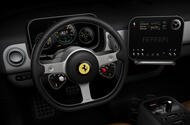
GT’s interior features scores of buttons, iPad-like screen and Nardi-inspired wheel; will be fully revealed in May
The first electric Ferrari will be named Luce and feature a radical new interior created under the direction of iPhone designer Jony Ive.
Due to be unveiled in full in May, the new EV will be a four-door, four-seat GT offering up to 1000bhp from a quad-motor powertrain.
Referred to as the Elettrica early in its development, the production version will be called Luce, Ferrari has now confirmed. In Italian, ‘luce’ means a light source, as well as being a colloquial term for electricity. Company boss Benedetto Vigna said the name reflects how the car is “lighting the future of the company”.
The interior and exterior of the Luce has been developed by design firm LoveFrom, part-founded by former Apple design chief Ive, who oversaw the styling of products including the iPhone, iPad, MacBook and Apple Watch, as well as the user interface of the iOS operating system.
Despite Ive having led the design, the Luce’s interior retains a large number of physical controls, rather than switching everything to a touchscreen.
Although car designers repeatedly cite the iPhone as an influence for installing touchscreens, Ive said he would “never” purely use touch controls for a car, “because it requires you to look” away.
Ive’s influence on the cabin is immediately obvious, though, particularly through the use of anodised aluminium and strengthened glass from specialist firm Corning – two key components of Apple’s products. The movable 10in central touchscreen is also very reminiscent of an iPad in its design.
Ferrari design chief Flavio Manzoni described the cabin as “unique” and “disruptive” to the industry.
Ive highlighted the extensive use of glass as an example of that, saying it was chosen over plastic because it’s both stronger and perceived to be more luxurious while being only 10kg heavier overall.
The British designer insisted that the cabin had to be functional, interactive and “alive”, which is why it makes extensive use of physical switches.
“This idea that because the power source is electric the interface should be digital is nonsense,” said Ive. “That makes no sense to me at all.
“One of the things that we felt very strongly about was we wanted to explore an interface that was physical and that was engaging, and that was to take the most powerful parts of analogue displays and combine them with digital displays.”
This approach is most apparent in the 12.5in instrument binnacle. For example, the three individual dials (which display speed, power and so on) are created by two custom-made, wafer-thin Samsung OLED screens placed on top of one another and convex glass fitted to give the look of something more analogue. There’s even a physical needle for the digital odometer.
Ive said the main focus of the car “is about driving” and as a result “everything else augments that experience”.
An illustration of Ferrari’s desire to create an experiential environment includes what the firm calls its “key ceremony” start-up sequence. The driver places the square, chunky key – which is also made of aluminium and glass – into its special holder location. When it is clicked into place, the key’s yellow colour changes to black and the yellow is transferred to the drive selector, which Ferrari describes as a way of “transferring the power from the key to the car”. Ive said this alone took nearly a year to perfect.
Despite nods throughout the cabin to Ferrari’s heritage, most notably the three-spoke, thin-rimmed steering wheel, Ive said he was “not trying to be nostalgic” but wanted to create something that had “some gravitas and weight for the future”.
Ferrari chairman John Elkann described it as “timeless”.
Ferarri Luce: Key interior features
Steering wheel
The three-spoke and thin-grip steering wheel is a reference to the Nardi design that was fitted to some of the most iconic Ferraris of the 20th century. Indeed, it’s said to be inspired by Ive’s personal 250 Europa from the 1950s.
It features lots of physical buttons, a manettino for each of the electric modes (which vary power output from 50-100%) and the powertrain settings (which adjust the car’s character and how its power is used), as well as paddles that manage torque.
At launch it will be covered in a smooth leather, rather than the Alcantara, which is traditionally used liberally throughout modern Ferrari interiors.
Touchscreen
The radical cabin is centered around an iPad-like 10in touchscreen. It’s moveable via a chunky grab bar at the front, which is also designed to be used as a palm rest for when using the screen. At the bottom, physical switches control climate and media.
Ive said each feels different when used so the driver knows which one they are controlling without needing to take eyes off the road. Ferrari added that this creates “a compelling connection between driver and car”.
At the top sits a clock that features physical dials but a digital face, meaning it can also be switched to either a compass or a lap timer. Ferrari claims this was the piece of the cabin that took the most time to develop. Each hand is independently operated by its own three gears.
Instrument binnacle
The incredibly technical digital cluster is made up of eight different layers, of which the front two are separate (and bespoke) Samsung OLED screens. They are used to create a three-dial view: the middle one shows speed (and features a physical needle) and the other two are customisable based on the powertrain settings selected (for example, the left one can show regenerative braking and the right one can show the g-forces being pulled).
The black plastic-looking surface surrounding the dials is actually also an OLED screen that displays warning lights, turn-by-turn navigation and the shifting aid that is normally found at the top of modern Ferrari steering wheels. Why not just put it all on one screen? Ive said having two added more depth and was more interesting.
The binnacle is encased in the same anodised aluminium and is connected to the steering wheel column so both move as one, in an effort to improve visibility.
Center console, key and launch control
Designed to appear as if floating, the centre console is made up of a mix of leather and glass – the latter in both matt (for the most-used areas, to avoid fingerprints) and glossy finishes.
With an eye on functionality, there are two separate cubbies (one each for the driver and passenger), two cupholders, physical buttons for the boot operation and central locking and switches for all four windows attached to the console.
For rear passengers, a rear touchscreen gives a view of telemetry, such as speed, track time and more.
The key, made of the same aluminium and glass that adorns the rest of the cabin, has its own holder at the front of the console. It needs to be pushed into place for the car to start. The inverted-L-shaped shifter is also made of glass.
The launch control system is activated by pulling down on a grip that’s located above the driver’s head “like in a helicopter”. It’s flanked by switches that control exterior lighting settings, such as the foglights.