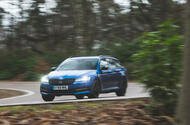
When size really matters: Nominative determinism on four wheels in the form of this exec marvel
In 2024, the fourth-gen Skoda Superb scored a rare five-star road test verdict.
It was one of just three cars to achieve the feat during that year, along with the Porsche 911 S/T and Hyundai Ioniq 5 N. Not a bad three-car garage, that. Anyway, it shows just how recommendable the latest Superb is.
Trouble is, despite being the most affordable car in its class, it’s priced from £38,000, so not quite the ‘everyman exec’ it once was.
But if we wind the clock back and look at the previous-gen Superb, we can save a shedload but sacrifice little in terms of tech, space or refinement.
In fact, the Mk3 does some things better than the Mk4: it has a higher-quality interior, more powerful engine options and more buttons to play with.
We will start, though, with the Superb’s party piece: its Goliath boot. The estate can hold 660 litres, or 2000 litres with the rear seats folded, while the saloon-shaped hatch swallows a seats-up 625 litres. Not even a Mercedes-Benz E-Class can beat that, never mind the majority of family SUVs.
The rear seats are similarly accommodating – kids can stick their legs out straight in front of them and there are Isofix points on the outer rear seats, plus enough width in the body for three booster seats across the back.
The Superb is just under 4.9m long and a shade under 2m wide and can feel a little unwieldy to manoeuvre. All-round parking sensors are standard, though, and top-spec Laurin & Klement cars have a reversing camera to help keep those bumpers box-fresh.
Most Mk3s are equipped with the Volkswagen Group’s familiar 2.0-litre TDI with 148bhp. It’s a willing unit with a useful amount of torque and decent refinement; the 1.6-litre diesel and 1.4-litre petrol both lack muscle for a car of this size.
For more punch, the near-200bhp 2.0-litre diesel and 217-276bhp 2.0-litre petrols are where it’s at – they’re favourites with the police and capable all-weather performers in four-wheel-drive form. Higher-powered diesels are rated to tow 2200kg, and they do so effortlessly.
With the 2019 facelift came a plug-in hybrid, the iV. Real-world electric range is around 30 miles, and while the batteries add weight and rob boot space, its 215bhp makes it a strong performer, and it doesn’t cost a lot more as a used buy.
The standard six-speed manual gearbox is easy to use, and while the optional six- or seven-speed DSG dual-clutch autos are mostly fine, they can dither and are more expensive to fix if there’s a fault.
The Superb could be optioned with adaptive dampers (look for ads that mention Dynamic Chassis Control or DCC), which boost suppleness in Comfort mode and firmness in Sport, but in all cases a Ford Mondeo of the same vintage has the edge when it comes to rounding out battered roads.
The Superb isn’t exactly ‘fun’ to drive, but it’s perfectly pleasant to smoke around in. On smaller wheels, refinement is on a par with premium rivals. We would avoid the Sportline with its 15mm suspension drop and 19in alloys unless you really can’t forgo the kerb appeal.
Despite costing less than rivals such as the Vauxhall Insignia when new, used examples are now worth more on a like-for-like basis than even the Superb’s posher cousin, the Volkswagen Passat. Don’t let that put you off, though, because residual values should remain strong.
What to look for
Gearbox: Three main versions of the DSG gearbox were used in the Superb: a six-speed wet clutch, a seven-speed wet clutch and a seven-speed dry clutch. The dry-clutch unit – the DQ200 – is the one to avoid, typically fitted to lower-powered models, but double-check using the VIN (you might have to pay for this). Listen out for a metallic squeal as the gearbox changes up from first through to third. Even the other ‘boxes should be serviced more regularly than VW suggests (some owners suggest 20,000 miles). Or buy a manual-equipped Superb for peace of mind.
Electrics: Check there are no messages about the Front Assist collision warning system, which can need recalibrating – expensively. The electric tailgate is also known to fail.
Tyres: Economy-oriented Greenline versions of the Superb have standard-fit stop/start ignition and brake energy recovery, along with longer gear ratios. Their low-rolling-resistance tyres are pricey, and used examples are unlikely to still be wearing them.
Haldex system: Replace the fluid and filter every three years/30,000 miles. At this age, the need for a new pump and O-rings is likely.
Also worth knowing
Entry-level S models look quite plain, with cloth seats, a small screen for the radio and a rather humdrum appearance. But the quality of the cabin materials is agreeable and you still get a good level of equipment (DAB radio, Bluetooth, air-con and cruise control). As you work your way up through SE, SEL, Sportline and finally L&K at the top, the Superb begins to feel like a true luxury car.
Higher-spec cars can be found with suede or leather seats (in black, brown or beige), adaptive cruise control, Dynamic Chassis Control, a panoramic sunroof and a 9.2in infotainment screen, all of which makes them feel almost on a par with the newer Superb in raw functionality and equipment terms.
An owner’s view
Peter Pratt: “We owned our 2015 Superb SE L estate for a few mostly happy years. Having bought it with 75,000 miles, we added only another 10,000 because it had a couple of faults with the cooling system, despite having had a new water pump. It was enough to send us back to a Honda Accord. We did love the Superb’s boot space and rear leg room, but the refinement wasn’t particularly impressive (ours was on 19in wheels, however). It was a compelling all-round package, though, and I can see myself trying another soon.”
How much to spend
£2500-£4999: Looking a bit leggy at this price point, but the fact that some are showing over 200,000 miles is perhaps a good sign in general.
£5000-£9999: Lots of choice here, with mileages between 80,000 and 150,000. Many look well cared for, though.
£10,000-£19,999: The bulk of the market here, with a good selection of average-mileage cars, in all specifications and both body shapes, including facelifts.
£20,000-£32,000: Everything from low-mileage, low-spec facelifts to the very last almost new cars.